
Against Babel: Eurasianism, Pluralism, and God-Pleasing Unity
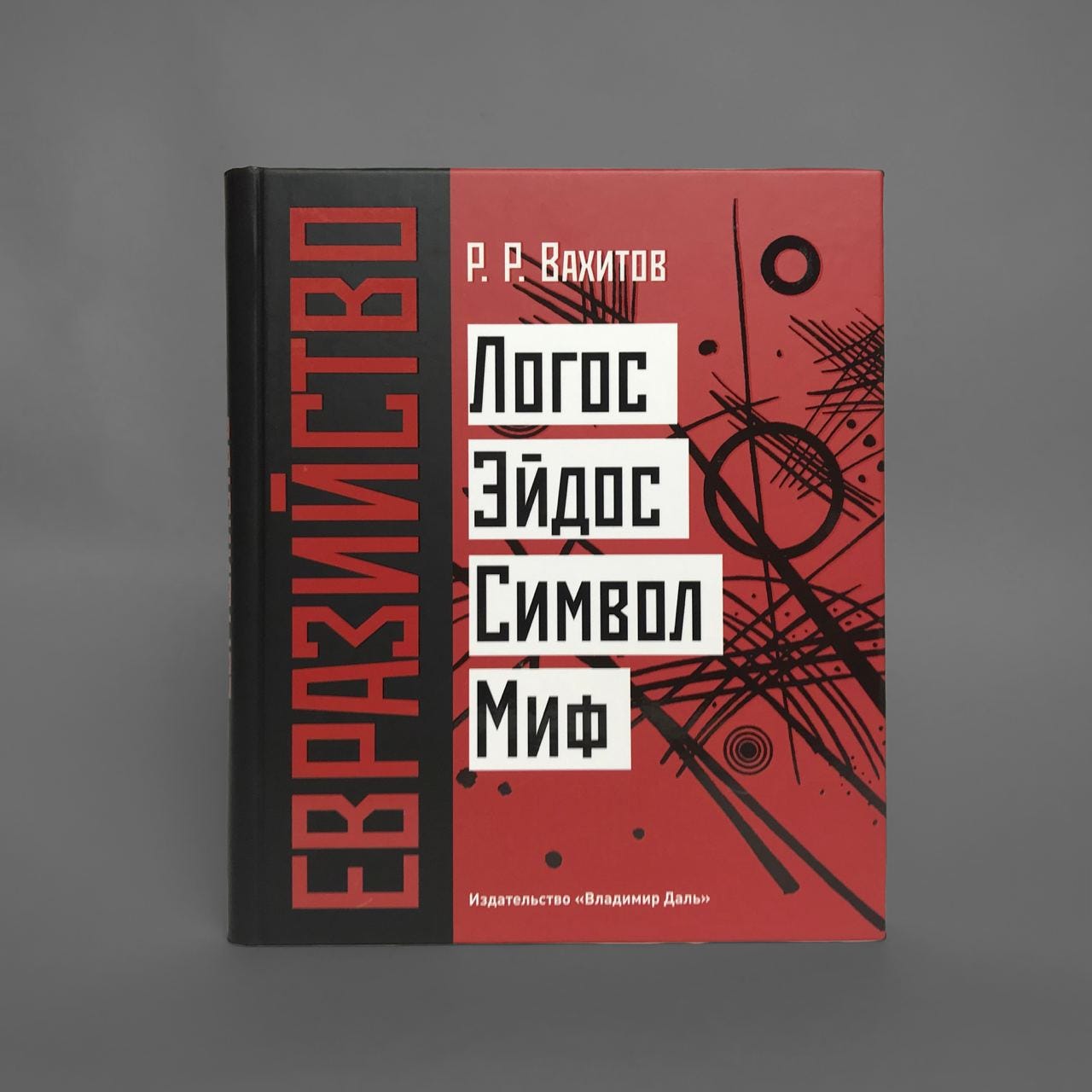
Book Review - Eurasianism: Logos, Eidos, Symbol, Myth by Rustem Vakhitov


There is no shortage of obstacles to understanding Eurasianism, particularly for Western audiences. Be it the limited selection of translated texts from the classical Eurasianist corpus (a problem myself and the team at PRAV are slowly rectifying with our Foundations of Eurasianism series), the sheer complexity of the ideas in question, or the slew of hyper-politicized misinformation clogging contemporary information sources. The American obsession with pigeonholing Eurasianism as a far-right, fascist worldview is only matched on the opposing side by the work of the very political figures about whom these academicians are so concerned in the first place.
I am not sure how Western scholars would cope with a book like Rustem Vakhitov’s Eurasianism: Logos, Eidos, Symbol, Myth. Vakhitov, an associate professor at Ufa University of Science and Technology, academic columnist, and political commentator, has not only devoted decades to the study of Eurasianism; he is also a representative of the underrepresented left wing of the modern Eurasianist movement, and a regular critic of the ideology’s “right” variation… and of Alexander Dugin in particular.
That said, Vakhitov’s book showcases a complexity and depth of understanding of the subject matter that would be just as hard to reduce to a crude political category as the first generation of Eurasianists themselves. Vakhitov’s Eurasianism is exceptional in how it operates simultaneously on (at least) two levels: it functions as a concise but substantial primer on the key components of the movement for uninitiated readers hoping to orient themselves, while simultaneously offering an original, complex, and genuinely challenging contribution to Eurasianist scholarship for those already familiar with the terrain. Given the ideology’s niche position, this dual function is something of a necessity, but it is executed admirably here.
The first third of the book examines the topic using what I can only describe as an apophatic methodology, working through several of the major misinterpretations of Eurasianism and breaking down what each of them fails to grasp: that Eurasianism is a “mood” rather than a system; that it is merely a degraded form of neo-Slavophilism; that it represents a trauma response to the annihilation of Russian culture after the Revolution; that it is a “totalitarian” offshoot of the European conservative-revolutionary tradition; that it is simply a Russian variant of European imperialism; that it reflects the anti-Western resentment of a semi-colonial periphery, and so on. Each of these reductionist positions is addressed in turn, clearing the field for a more sophisticated and original attempt at understanding the movement in its “blooming complexity.”
The majority of the book is oriented around this original interpretation, the essence of which I will strive to condense here. Like Marxism, Eurasianism is complicated by the fact that it is both an object of inquiry and a methodological framework through which inquiry is conducted. While examining something through its own lens might seem like a conflict of interest, the book can more productively be understood as an exercise in critical self-examination. The methodology employed is both fully original and entirely in keeping with the spirit of Eurasianist syncretism.
The central conceit of Vakhitov’s scholarship in this work is his approach to Eurasianism through dialectics—sussing out the ideology’s core contradictions and arriving at conclusions through the movement generated by the opposition of binary pairings. This dialectical approach immediately sidesteps one of the most common stumbling blocks in Western scholarship on Eurasianism, which tends either to latch onto one side of its seemingly contradictory political elements, or to acknowledge both and conclude that the ideology must therefore be fundamentally incoherent. The dialectical method feels uniquely suited, and perhaps even essential, to clearing these hurdles, especially when one understands that the exploration of contradiction within unity is itself a central tenet of Eurasianist thought.
Having completed his work of determinate negation, Vakhitov turns to the far more difficult task of articulating positive, definitional content. This is where the book gets truly interesting, as it becomes clear that the author intends to fuse a Hegelian-Marxist dialectical method with a classical—and, later, even biblical—perspective more commonly associated with the intellectual right. This positive content begins with Aristotle and an effort to move beyond Eurasianism’s historicized, dynamic expressions in order to determine its eidos, its essential form or defining nature.
Vakhitov distinguishes between the “material” causes of Eurasianism—its central influences and adaptations—and its formal cause, i.e., its defining structure. He identifies three major material influences from which the ideology was constructed: Trubetskoy’s relativistic culturology (Europe and Humankind), Vladimir Lamansky’s concept of the “Middle World,” and the theory of liberal imperialism as articulated by Petr Struve and the young Petr Savitsky. Together, these influences shaped Eurasianism’s emphasis on the unimpeachable value of civilizational plurality, the development of cultures through topogenesis1, and a sustained critique of Western hegemony.
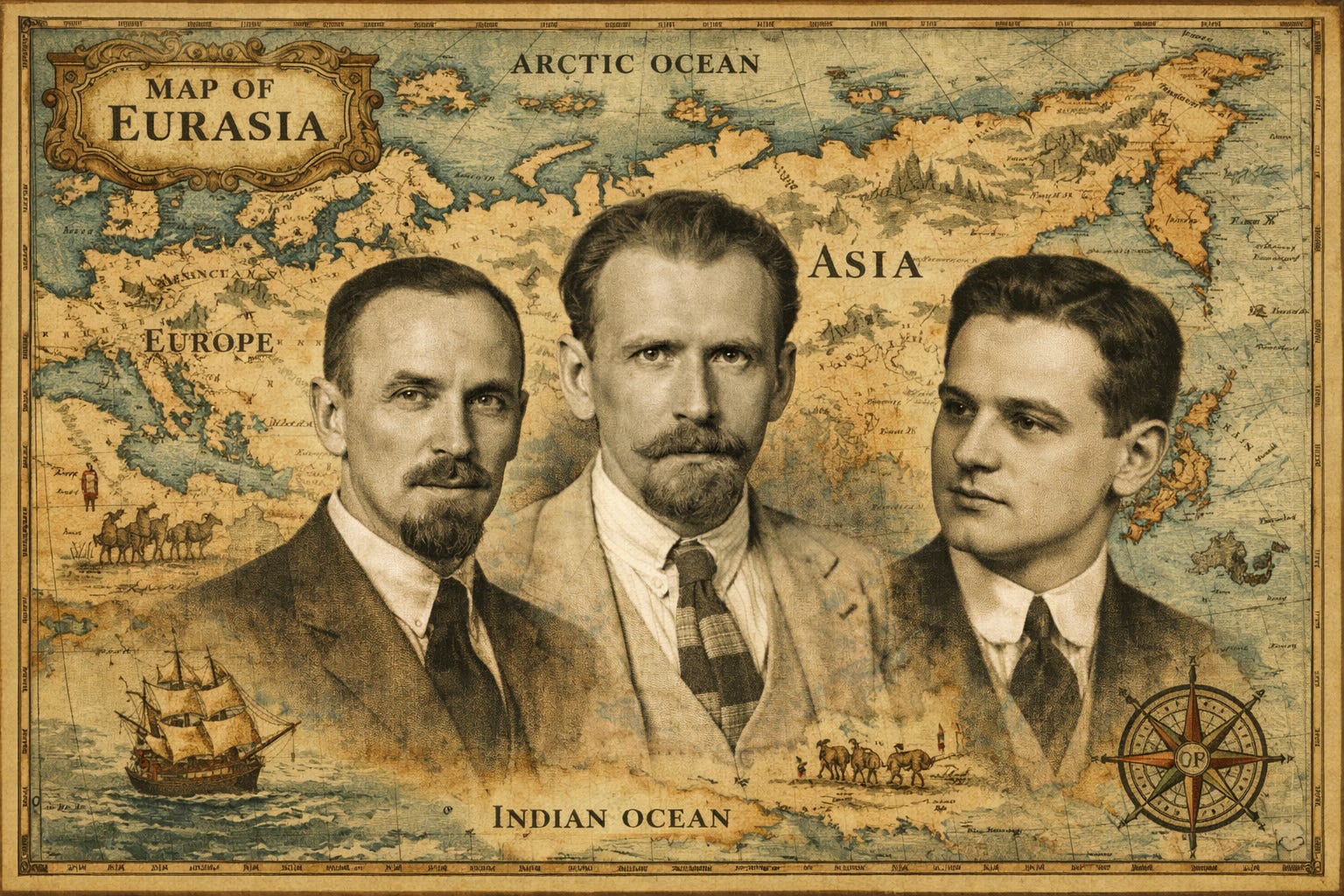
It is here that Vakhitov introduces one of his most significant contributions to the study of Eurasianism: the claim that Eurasianism is best understood not as a fixed ideological program, but as a methodology capable of distinguishing between organic and artificial forms of unity. Attempts to define Eurasianism empirically or positivistically invariably collapse into long lists of seemingly unrelated positions—Eurasia as a unique civilizational type, a critique of global Western dominance, a revisionist interpretation of the Mongol legacy, and so on—and in so doing, expose apparent internal contradictions. Understanding Eurasianism instead as a framework for making dynamic judgments about the legitimacy of unified forms brings us much closer to its eidos than any catalog of positions ever could. One of the most important distinctions that emerges here is the argument that Eurasia constitutes an organic, God-pleasing unity, while formations such as the British Empire serve as paradigmatic examples of artificial, non-God-pleasing unities.2
Chapter Three further develops this framework by examining the core categorical oppositions that structure Eurasianist thought: unity ↔ multiplicity, God-pleasing ↔ non-God-pleasing, personality-oriented (lichnoe) ↔ impersonal (nelichnoe). This near-taxonomic breakdown of types of unity is denser than the preceding material, but it is essential given the revised definition of Eurasianism advanced earlier. It is also necessarily challenging, as the question of “personality” (lichnost’), here explored in-depth, represents one of the sharpest internal tensions within the Eurasianist tradition.

In Eurasianism, “personality” refers not to the individual, but to a supra-individual, collective unity—an organic, hierarchical, historically concrete, and internally complex subject that may take the form of a people, a civilization, or a cultural world. Eurasia itself is such a “personality.” As a collective personality, Eurasia possesses a God-given identity and purpose, as well as a form of collective consciousness in a broadly Hegelian sense—in other words, it has a soul.34 Artificial unities, such as Western thalassocratic empires, lack personality and therefore also a soul, rendering them both fragile and dangerous. Deprived of organic cohesion, they are forced to rely on coercion and brutality to maintain their unnatural form.
The third chapter then turns to Eurasianism as a “symbol,” drawing specifically on the usage developed by the Russian philosopher Aleksei Losev. For Losev, a symbol is not merely an image that represents something else; a symbol contains its meaning within itself and functions as a generative node in the ongoing production of meaning. Though concrete and visible, it possesses an inexhaustible excess—something like a fusion of the sacred density of a rune with the formal abstraction and infinite extension of the symbol π. Vakhitov illustrates this with the example of the Bronze Horseman in St. Petersburg: the statue is not a closed semantic circuit, but a site of disclosure that invites endless reinterpretation across a range of tensions: state power ↔ the individual, tradition ↔ progress, order ↔ chaos, and so on.
To understand Eurasia as a symbol in this sense is to move beyond empirical description toward an open and dynamic field of analysis. The symbol becomes the ideal site through which Eurasianism’s dialectical motion and its transcendent, eidetic essence intersect. It would already have been illuminating to explore Eurasianism through dialectical and eidetic lenses alone, but by introducing the Losevian symbol, Vakhitov provides a conceptual space capable of synthesizing and sustaining both dimensions simultaneously.
The final chapter serves partially as a summation of the preceding arguments, but it also introduces Vakhitov’s culminating concept of myth. Remaining within Losev’s terminological framework, Vakhitov proposes that Eurasianism be understood not only as an ideology or methodology, but also as a mythos—a narrative that reveals the essence of a personality. Here, the language and lens become explicitly biblical. Myth discloses moments in which inner essence and outer appearance briefly coincide, producing miraculous events that reveal what a personality truly is and what it is meant to be. Miracles do not violate the laws of nature; rather, they mark points of contact between the fallen, illusory world and the divine essence that underlies it.
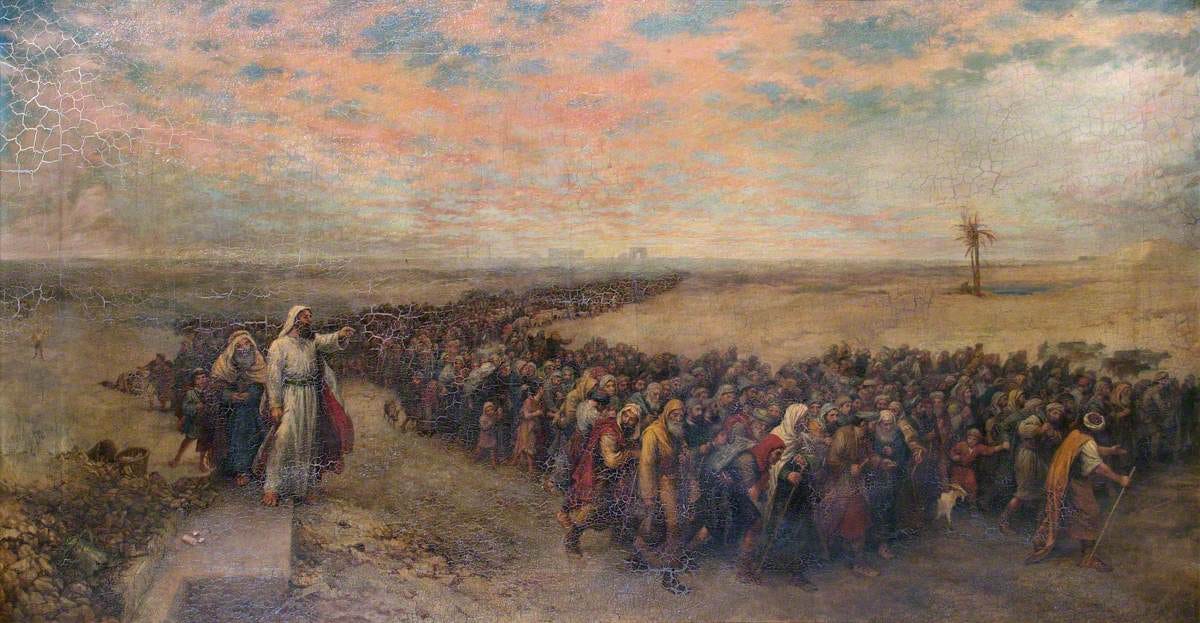
Two of the central miracles associated with Eurasianism are the stories of the Exodus and the Tower of Babel from Genesis. Given that the core figures of the Eurasianist movement were exiled from a homeland they understood as providentially ordained, it is hardly surprising that they would gravitate toward the narrative of Israelite exile, wandering in the wilderness, and covenantal return. While often noted as a reference to Dostoevsky, the title of the movement’s first collection, Exodus to the East, also carries unmistakable biblical weight.
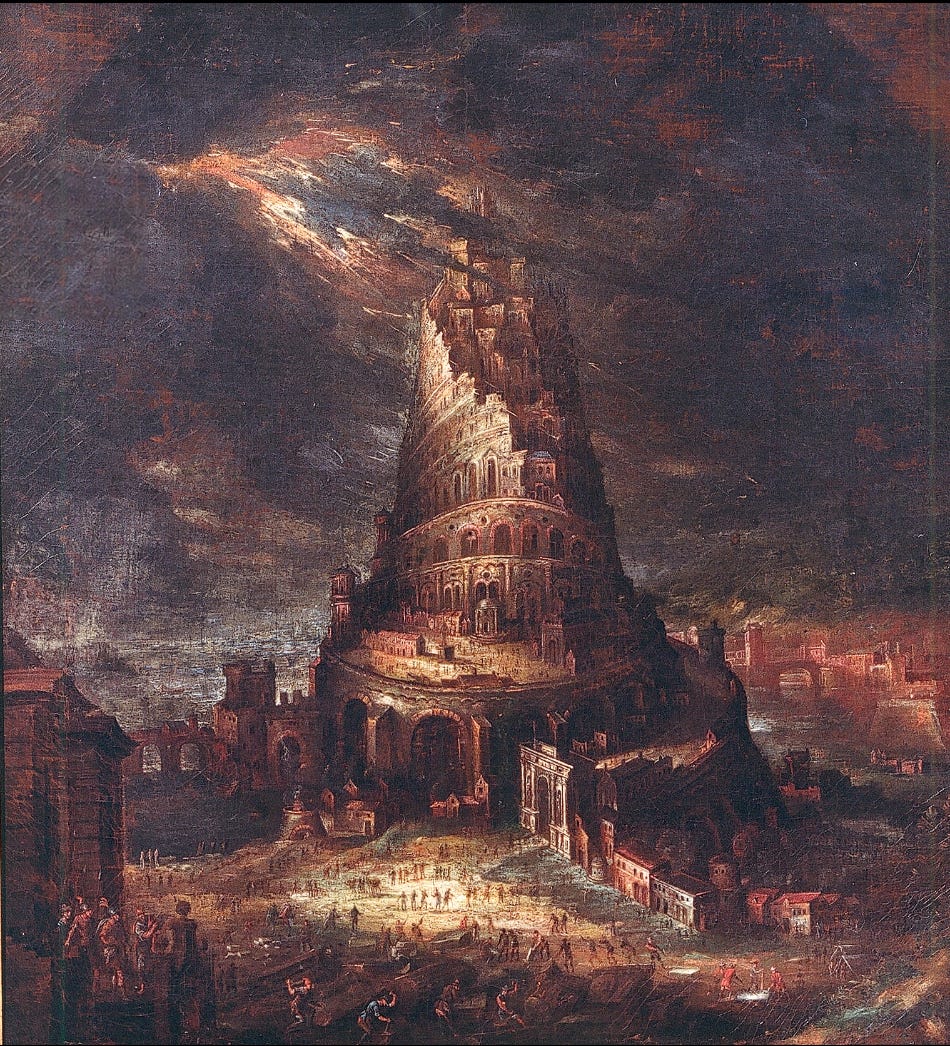
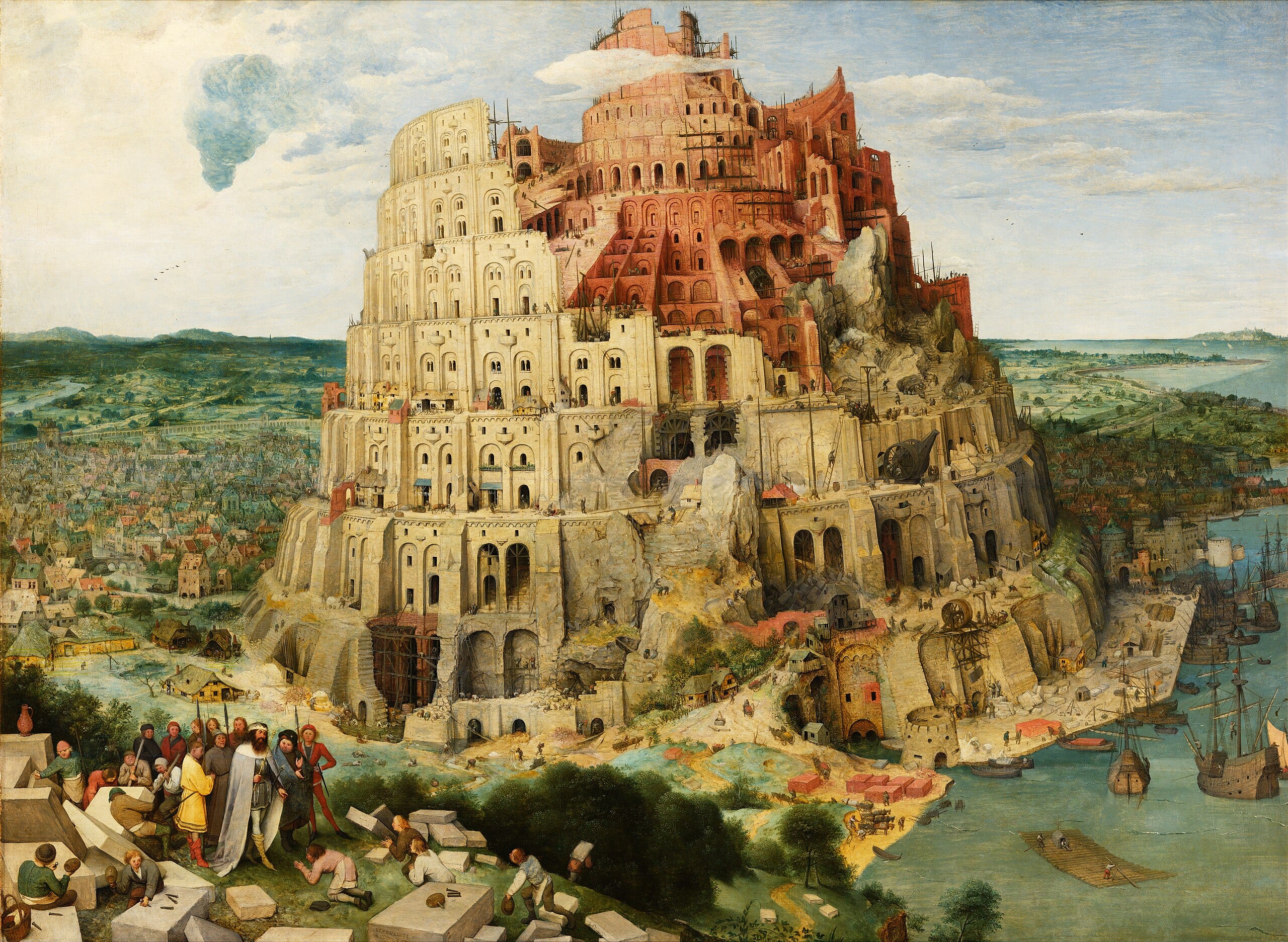
The second biblical myth, the Tower of Babel, depicts humanity’s hubristic attempt to construct a unified, universal culture capable of rivaling heaven itself. This effort is thwarted through the “confusion of tongues,” as humanity is divided into a plurality of languages and cultures in order to halt further theomachy. Trubetskoy interprets this story as a clear affirmation that cultural difference is God-pleasing and integral to the divine order of the world. Western imperialist attempts to impose a universal civilization thus appear as modern efforts to scale the vault of heaven itself. Any project aimed at constructing a global civilization, the Eurasianists argue, is therefore both false and opposed to God’s plan.
The final miracle is that of naming: forgetting one’s name, and finding it again. At various points in history, Eurasia appeared to have lost its path and essence—after the early period of Rus’, during the Tatar Yoke, under Peter the Great’s Westernizing reforms, and then under the Bolsheviks. Yet, every attempt to divide, overwrite, or suppress Eurasia’s identity has failed, because the essence of the Eurasian land is divinely ordained. Paradoxically, each effort to erase this identity has only served to strengthen it; as the submerged myth resurfaces, the upper strata are stripped away, and deeper truths embedded in the land itself reemerge.
Like the Israelites, the Eurasianists may find themselves lost, scattered, or exiled, but these conditions only heighten the intensity of those miraculous moments when the true name is rediscovered, whispered back into being by the tongue of the world. In this light, Vakhitov reminds us that the Book of Exodus was once known simply as the Book of Names.
Myths disclose the hidden truths of history, identity, and destiny, and for all of its scientific and ideological rigor, Vakhitov ultimately reminds us not to lose sight of the religious core of the Eurasianist idea.
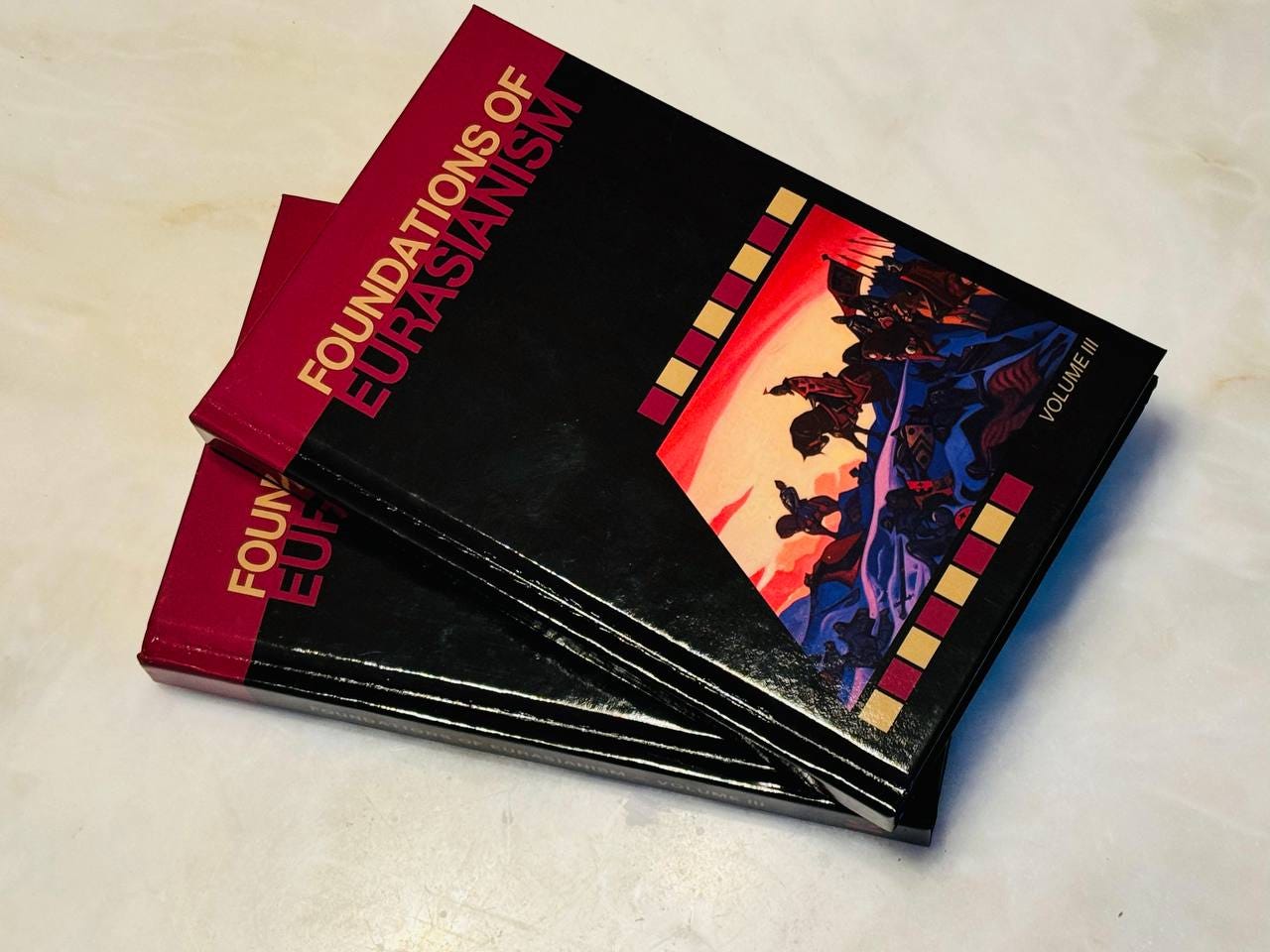
For more by Rustem Vakhitov in English, check out his in-depth, critical introduction to Foundations of Eurasianism Vol. III (PRAV Publishing, 2024).
Topogenesis [mestorazvitye] refers to the process by which a culture, people, or civilization takes shape through its organic development in and with a specific geographical space. It emphasizes that historical, cultural, and spiritual forms are not abstract or transferable, but arise from a living interaction between land, climate, landscape, economy, and collective human life. In Eurasianist thought, topogenesis rejects the idea that civilizations can be freely exported or imposed elsewhere, insisting instead that each culture develops according to the internal logic of its place of development.
It is outside the scope of this review to examine the breadth of material presented in support of this argument, but interested readers can find the details in chapter 2.
It is critical, however, to understand that Trubetskoy is not implying that Eurasia can think and express itself as if it were some singular identity distinguishable from the people that make it up. Eurasia expresses and understands itself in the collective work and thought of its people.
While slightly outside the scope of this review, Vakhitov here also breaks down the distinction between Trubetskoy’s “conciliar personality” [sobornaya lichnost’] and Karsavin’s “symphonic personality” [simfonicheskaya lichnost’] in a comprehensive way. This division is of critical importance for understanding the Clamart split and classical Eurasianism’s division into a “right” and “left” wing.
Here's my article on Vakhitov in Finnish that includes a link to this book review: https://markkusiira.substack.com/p/rustem-vakhitovin-vasemmistolais