Searching for Agartha
by Boris Nad

Excerpt from The Reawakening of Myth (PRAV Publishing, 2020) + 20% discount code for subscribers below
The history of peoples is made by the unwritten history of great travels and world travelers — a history that began long before Herodotus or Marco Polo, in the Neolithic or even earlier, in some fantastical age of mankind. Perhaps even at the dusk of the primordial Golden Age, with glaciation or flood, and with the first in a series of catastrophes faced by the human species.
Then followed eras of the migrations of peoples and races. If we believe Plato, then the Atlanteans were the first colonists in the world, and they came from the West. Others say that their ancestors were the Hyperboreans, who fled snow and ice in the Far North of the continent. Over the course of subsequent history, peoples would move from North to South and from East to West - and not otherwise. This constitutes their course through history - a path of aging, degeneration and, at times faster, at times slower, of inexorable decline. This is how great conquests began, those that encompass immense regions, entire continents, and this is how great wars start, like the one that raged under the walls of Ilium - or was this only a shadow of some mythical war waged in the far deeper past, during the mythical age of the Earth? Perhaps at the beginning of time, “in illo tempore.”
They did not rush towards unknown and exotic lands, but towards their lost homelands, towards mythical lands of the beginning, towards the riches of the Golden Age. Towards primordial, Edenic abundance. Towards Paradise Lost, such as the Biblical one, which we have not stopped searching for here on Earth even today.
One Islamic mystic, Suhrawardi, claimed that after death the soul returns to the homeland, for merciful Allah himself commanded this, and this would not be possible if he had not previously resided in it. This mythical homeland is to be found somewhere in the “spiritual East.” In order to find the strength for this, we must start from the spiritual West, the “Western wells of exile.”
The true journey, true adventures of the spirit, this Sheikh taught, start in the West. This is a place like a grave, a stockade of the burial-place. Arriving on the soil of an unknown continent, Christopher Columbus thought he had discovered the New Earth mentioned in the Apocalypse of St. John. The famous seafarer believed he was in the Gulf of Paria, and in its fresh currents discovered the origin of the four rivers of the lost heavenly garden, Eden itself. “God made me the messenger of the new heaven and the new earth, of which he spoke in the Apocalypse of St. John, and before that through the mouth of Isaiah,” Columbus proclaimed to King Juan, “and he showed me the place where to find it.”
The end of the world, as it is written in the Book of Prophecies, is preceded by the discovery of a New Land, a New Earth, the conversion of unbelievers, and the destruction of the Antichrist. Evil will be destroyed on Earth once and for all.
What is the link between Agartha and America? Is it the same thread that interconnects all continents? Could their appearance, or rather re-appearance, on the horizon of world history represent a sign of the “final times”, the “End Times?” The “secret” of America was known to the Vikings, the Egyptians, and the Phoenicians even thousands of years before the Portuguese and Spanish seafarers.
Esotericists and the adepts of secret societies, mystics and conjurers, astrologers and neophytes, the followers of secret cults and obscure conspirators - they are all still weaving their dark webs around Agartha and the deep mysteries that hide this underground kingdom.
America is not only the land of the Apocalypse – a story that speaks about the end of the world and the last revelation. The first newcomers identified America with paradise, where even the trees and plants spoke the “hieroglyphic language of our Adamic or primitive state.” The New World was for them a projection of paradise on Earth, by which God baptized his chosen people - the New Israel. Here the attribute “new” has the meaning of “godly.” Others identified America, on no lesser grounds, with Atlantis, whose downfall was described by Plato. Failing to observe that the Greek philosopher was precise in the details he gave, and that, besides the island of Atlantis, he also mentioned a “land in the West surrounded by ocean on all sides.” This, there can be no doubt, is the North American continent. America is only its shadow, its projection in the Far West, the “false Atlantis.”
Herman Wirth spoke of the vanished land of Mo-Uru (the Biblical Moriah where Abraham wanted to sacrifice his son), an isle in the North-West Atlantic, a lost sacred continent. The land of Mo-Uru is the real Atlantis.
The India of the Middle Ages and later, towards which world travelers were drawn, is just as much or even more so a mythical land and not a mere geographical fact. Brazil owes its name to Hy-Brasil, a mythical land of Celtic legend. Why did Siberia ultimately become the “sacred soil” of the Russian Empire? To Yesenin, Russia is paradise, or is even more important than paradise. Taken together, Russia and Siberia, or their Far North, are according to some researchers the actual mythical Hyperborea - the ancestral homeland of present mankind, or at least part of it, the homeland of god-men, the divine race of the Golden Age. One researcher thought he had discovered in Russian Lapland the ruins of the temple dedicated to Hyperborean Apollo and the mythical Thule - the Ultima Thule in which the ancient Greeks believed.
America is, of course, not the mythical island of Atlantis that vanished in the Atlantic Ocean at the very dawn of history. It is actually the Green Land, the Land of the Dead, the “Kingdom of Shadows'' in the West that is mentioned in the legends and myths of many peoples. America is Trans-Atlantis. What is the meaning of the reappearance of a dead, sunken continent, on the horizon of world history? In the same way, Agartha is also a “land of the dead'' which, as prophecy holds, is still to be discovered in the depths of the underground. In historical times, this reportedly was realized by some travelers and seekers. One of them was a Mongolian hunter who could not keep his secret, and thus had his tongue cut out by lamas. The Lama Djamsrap spoke of this in his book. Another was an illiterate Norwegian sailor who claimed to have lived in Agartha for several years. The reader will see that these fleeting mentions are not without grounds, and that America and Atlantis are closely connected without the topic of Agartha, the mysterious kingdom hidden in the everlasting dark, deep underground, and deep in the past. It is closely connected with the worlds of the dead and the past - with the past that refuses to die. And it verily conceals many secret histories of the human race.
At any rate, there is no single land, island, or continent in the world that is a mere geographical certainty. The whole Earth is a sacred text, a holy book written in special signs - or at least this is what mystics and esotericists believe. The words of this text, it is thought, were written by God himself. Every journey is, in fact, a pilgrimage, for we are always walking on sacred ground. Every land and landscape, far and near, possesses hidden meaning and secret significance - spiritual, symbolic, eschatological, and even profoundly mystical. A landscape is at once both a physical and spiritual reality. This is the domain of a secret, mysterious science - mystical and sacred geography - whose knowledge, as happens, has been lost forever over the course of centuries or millennia.
If the discovery of America, or rather the return of America to history, triggered such unrest among peoples, then what will happen if the prophecy of the end of the world is fulfilled and the secret Agartha becomes known to all of humanity? It is prophesied that the people of Agartha will once more come out onto the surface of the Earth. And likewise, Paradise, the Garden of Eden, is hidden somewhere in the East. It is in the East of the “wise sages of Tatary”, Swedenborg claimed, that we should search for the “long forgotten word.” Others say that we are in Hell, and that paradise, the Biblical one, is hidden in the same place.
Legend claims that somewhere, in the depths of the Earth, in dark caves and secret passages, there still lives a secret, mysterious people, one hidden from the sight of others, that this is known to only a few chosen ones on the surface, and that this knowledge is a strictly guarded secret. Or maybe it was until recently.
This secret kingdom, as we have already said, is called Agartha. This legend is ancient and comes from remote prehistory. Agartha is spoken of in the legends of diverse peoples - white, red, and yellow - in both East and West.
Travelers who have set their minds to find it have whispered about it. Caravan merchants have told exhilarating tales of it in inns and on mountain trails, in deserts and in remote corners. It is known to Tibetan sages whose teachings nourish monks and lamas.
The common crowds, meanwhile, ridicule and laugh at such tales as the superstitions of the uneducated and gullible.
***
I don’t remember the exact moment when my search for Agartha began. It must have been in the early days of my childhood. I surmise that everyone's childhood is marked by dreams that we later forget or hold in contempt in our mature age. In those days, I dreamt that I owned an underground castle led to by marble steps, and that some joyous event opened the path to the castle.
A secret is buried deep in the ground. The secret door that led to the castle was in the foothill of some giant tree, in a forest in the vicinity of a town, a forest which extended to our estate outside of Moscow. The entrance to the castle was hidden, and its ancient stone steps were covered by soil and dry leaves - the dreg of many centuries. The underground castle comprised countless, fabulous chambers, and was reminiscent of the caves of the island of Monte Christo. Whoever steps inside would be transformed into an enlightened being wreathed in glory rather than plenitude. The first of the magnificent chambers rested in semi-darkness and imperial purple. Torches hung on the walls, and if I lit the first one, then diamonds and pearls would scatter across the stone floor. Rubies glistened in chests. I was in possession of unsurpassable wealth, wealth not even of this world: golden coins forged by the hands of sorcerers or dwarfs. They were my servants, my reticent helpers. The underground world is inhabited with beings who are not human.
No one could guess my secret. Whom could I even entrust with such a secret? The silence increased my powers.
In January I turned 70. January is the month of the God Janus, the God of beginnings who has two faces. One looks towards the East, the other towards the West. One, as Ovid said, looks forward, and the other behind: into the past and into the future. One is happy, the other is sad. The moment of triumph, the moment of the fulfillment of our boldest dreams, those upon which we have based our whole preceding lives and to which our reality is subordinated, contains the bitter taste of our defeat: our highest hopes are extinguished with it. This was felt even by the greatest favorites of the Gods, such as Caesar or Alexander, in the moments of their deaths, if not before. Joy is passing and short-lived. Loss, on the contrary, is final and irrevocable. That is why our lives are reminiscent of passing through a valley of tears.
In olden times, I was in all likelihood a very spoiled and unbearable brat. The guilt for this was no doubt shared by my grandfather and governess. The governess’ name was Aglaia. Aglaia Prokhorovna - that is how we were to address her, but for me she was just Aglaia. My world consisted of books and strange stories, mostly those given to me by my grandfather. Among them were luxuriously illustrated novels for boys, such as The King's Messenger by Jules Verne, or his Journey to the Center of the Earth. I would often spend the afternoon hours in his library. That is one of those magic places we remember from our childhoods.
I would interrupt him in the evenings or late afternoons while he was working at his writing desk. Such privileges were not enjoyed by my father, or my mother - his daughter. This was in his house in Saint Petersburg. In August, under aslant rays of sun that did not set even at night (like in the mythical Hyperborea), his library was truly like a cave, and he looked like a monk, or a druid, a hermit with a beard, similar to the hermit I saw in Optina Pustyn.
At the time I had a black cat who followed me everywhere, and I gave him the name Behemoth – the name of a beast, a Biblical one, a land-monster who fights Leviathan, the monster from the deep sea. This black cat would come back to life in our literature, such as in Bulgakov’s novel, which must be well known to you. It would bear the same name.
He was my companion in adventures which I am no longer capable of describing. He spoke with a human voice and reminded me of the Puss in Boots of children’s stories. That fairy- tale cat, one scholar of myth claims, is in fact a god from the Neolithic, from the younger Stone Age, who over time receded into the guise of a fairy tale creature, the famous hero of children’s books. Maybe he existed only in my imagination.
In my imagination, I was that enigmatic child - a miller's son, the youngest of three brothers. In Russian fairy tales, such a boy is usually called Ivan. A similar boy is also a king's messenger, one who carries a secret message, upon which depends the fate of the kingdom and the happiness of millions. The messenger arrives at the last moment. In that last and decisive moment, I would whisper secret words in the ear of the Tsarina, or would put a secret letter, sealed in wax, into her hand. She would praise me with a smile and a soft kiss on my forehead. In that moment, her eyes would be filled with tears. By virtue of this, I became a favorite of the court’s ladies-in-waiting. The king himself looked at me with gratitude, and firmly clasped my small hand.
Hiding under the crinolines of those ladies-in-waiting, there is no doubt, was my mother, my sisters and cousins, distant and closer, and my governess. Between my mother and the governess there was a visible, insurmountable rift, unfathomable to a child's mind. The beauty of my mother was delicate, the sophisticated beauty of a refined and disdainful aristocrat resembling Botticelli's models. The beauty of Aglaia Prokhorovna recalled the beauties of Rubens' paintings. It was the sensual and healthy beauty of a rounded peasant, a Russian woman. The same one smiling today from Soviet posters, the beauty of the kolkhoznitsa, the peasant, or the worker.
Above these imaginary portraits stood a portrait of my grandfather - a cruel face with small eyes and high, almost Mongolian cheekbones, and an overgrown beard, similar to those of the Old Believers. He was Yusupov, an incorrigible Tsarist, killed in Moscow in the summer of 1918 under unclear circumstances. Finally, there is my father. A strict face with deep blue eyes. A well-groomed blonde mustache, and a rubashka the color of soil. Or at least that’s how he was in my memories. He died in an unfortunate incident in Kerch, Crimea. I see him, as if in a dream, as he walks in marching steps. My chest is filled with pride. Everything in these dreams is so clear and natural.
It is summertime. The sun is bright. We are standing in some wide yard - all streets in Russia are wide, and buildings are monumental. Golden and multicolored turrets in the shape of a bulb. Ringing bells, maybe from the church of St. Basil the Blessed. Lions in stone several times bigger than an average man. At the entrance are griffins. A stone dragon with unfolded wings is visible on the facade. It could fly away at any time. Somewhere in the vicinity is the Emperor himself, the Tsar, the real King of the World. The ruler who stands still, whose face is akin to a golden mask. Such are also the faces of the officers, guards, and cadets who surround him. In my memories and dreams, the emperor looks more like a monument in bronze, or stone, more like a bronze horseman from a poem of Andrei Bely than a man of blood and flesh.
The warmth of the chest under the white shirt is that of my governess. She hugs me closely. I can feel her excited heart beating. Russia, the Mother-Land, is in my head connected with her, not my mother.
Such are my earliest memories. She lifts me up, not too high, but enough for me to see the face of the Tsar, which appears as if cast in bronze or granite. Maybe only his eyes are smiling at me. His eyes are alive.
My life starts as a fairy tale, as an idyll. In childhood, life is just an endless adventure. Idyll and tragedy are actually one and the same play, one which we watch everyday in the theater of the capital city. And in this play, in every character and plot, there is duality. Wherever we approach the essence, everything splits into two.
This is the face of Janus, the God Janus, who is at once God of the beginning and God of the end. And here the first step depends on the last, and the last on the first.
Seventy years of age is a chance to put accounts in order. My life, this is quite clear now, has been marked from the very beginning by one secret mania: a search for the world hidden underground, or rather in the dark of time, in the past, which is dead now and will remain such forever. Only we can make it come alive. Once, a long time ago, I was born and grew up in a magical kingdom.
This is a pursuit for the lost Golden Age. Yet our only golden age is childhood, as we recognize at the end of our path. In it, and only in it, are hidden our deepest secrets and our Gods – the Gods of childhood.
No effort will bring it back, except our memories. There, and only there, in the past, like the shadow from Greek Hades of which Homer sang, wander our ancestors, our father and mother, our closest loved ones, those who persecuted us and those whom we have persecuted. Friends, and traitors, the saved and the damned; convicts and executioners, sinners and blessed, heroes and cowards. Reds and whites, Bolsheviks and Tsarists, communists and fascists, agnostics and believers, and above them all, our Lord God, whom we address in our prayers. Every one of them whispers their own history. Thousands and thousands of years of history of which we know nothing.
Over the years we inexorably near our end, our physical end, and at the same time we return to our beginning. This is the snake, Ouroboros, who ceaselessly devours his own tail. What happens after death, said the philosopher Heraclitus, who is remembered as “the Obscure”, people cannot anticipate.
Ouroboros is only time, an endless ocean in which we were thrown in, not knowing where we came from or where we are going. Not knowing who we are. We comprehend this only in the hour of our death.
***
It is morning, early morning. The sun illuminates the windows of my flat in Moscow’s outskirts. The sky is clear and endlessly blue. Once upon a time, centuries ago, people did not see the sky as blue. The world changes with the times, and everything in it, even the colors, has its own history. The blue-colored sky appeared in paintings only much later, starting in the Renaissance. It was not blue for Homer and his heroes, but some darker green or purple, the color of wine dregs.
I think about how, in the meanwhile, I have become a face without a name, as nobody has called me by my real name, the one I received at baptism, for years - no one besides a female kiosk worker who sells me a newspaper every morning. We hide our real faces under the masks of alien names.
I go down the stairs, as the lift is out of order, and then, after a short walk, I go back up the same stairs and drink my tea. In front of me is a still unopened issue of Pravda. I light my first cigarette as part of the morning ritual. The smoke rises up in a nearly straight line. The windows are wide-open. A stranger on the other side of the street, in a blue shirt and a tweed jacket, is trying to stay unnoticed - but this detail betrays him.
The one-bedroom apartment is of the size of a cell, whether a monk's or a prisoner’s. This is my space of freedom. The room is filled with books, and a writing desk in disarray and buried in papers. In one red folder is all that is left of the documents I’ve collected. I burned most of them in 1938, in some Berlin hotel. The rest I am burning now, slowly, piece by piece, in a Chinese pot made of jade, while I write these notes.
I am going through my memories. Memory is unstable and deceptive. Where to begin the story of Agartha, the world disappeared underground? Why would this story arouse any interest in the reader? A story of a world that lies much further than 20,000 feet under the surface of the Earth? Somewhere, in its warm interior, like a hidden heart. I do not know if that heart is alive or if what we see are the shadows of Homer’s Hades. Some of them, they say, are as old as this world, or even older.
This book – although I hesitate to call it a book – is probably never going to be published, and certainly not during my lifetime. Maybe these notes are not destined to see the light of day. In fact, this is almost certain. In spite of this, I am trying to write down a story so incredible that it seems as if it were a fantasy of the imagination, a darkened mind, delirium, or drunkenness. But still, it is true. I dare to say that it is authentic, word for word, as far as my unreliable memory has not distorted it. Or perhaps it is a dream, a mirage similar to what travelers lost in the desert experience.
Immediately after my death - I am completely certain of this - unknown people will enter my apartment with expressionless and indifferent faces and meticulously remove any trace of my life on Earth. Some of them will be my old acquaintances. Let the reader - if there is one, and a reader who is not just looking for superficial entertainment - forget the names and years. I am writing these notes as I remember them. The reader should not waste their time with visiting archives and libraries to verify everything I claim here. The names here are false for reasons that will soon become clear. Only those who already know the secret of Agartha will understand them, and therein lies the paradox. This story is not for anyone but the reader who is predestined for its symbols. It will come to life only in their hands.
There is one episode with which I would like to begin this story. It played out in 195* in the valley of the Uburtelin-Gol.
***
In the year 195* a Soviet archaeological expedition approached the valley of the Uburtelin-Gol River in the Mongolian Altai; the name of the river in Mongolian means “the river of black abysses.” The convoy of vehicles drove through beaten paths with difficulty, kicking up clouds of red dust behind it. There was a larch forest to our left. The treetops were motionless. We could feel the sultriness. The air was heavy, humid, without a whiff of wind.
A vast valley lay below. There was a red hill towards the North, standing lonely under the horizon, called the Devil's Hill. It belonged to the Khangai mountain range, a range, as the Mongols described it, made of dragons' teeth and stone turrets. It resembled a mirage, at once unreal and clear in every detail. A white cloud appeared anchored above its top. The cloud had a rosy lining.
When we reached the valley, overtaking huge rocks resembling cyclopean walls - or perhaps they were the actual walls erected by the Ispolins, the Nephilim, and the Titans of Greek myth – we dove into a sea of fog. The strands of fog were pierced by the sharp and smooth stone blocks of the Khangai.
Near the river, we noticed huge columns of red granite and their reflections on the motionless river surface. Even lower in the valley, green mounds, tumuli, showed themselves. On top of each stood a granite tombstone about two meters high with some kind of rune-like inscriptions. The whole valley was occupied by high mounds, overgrown with green and yellow grass. These mounds belonged, as we were told, to prehistory, to some undetermined period as remote from us as the mythical, bygone tales of the Earth.
While the expedition was getting ready to set up a temporary camp, five of us set out towards those columns or turrets of red granite. We passed a circular necropolis of a perimeter of some thirty meters, which the archaeologists planned to examine. There was a pile of stones in the middle of the center; stone blocks rose up on the rim of the outer circle, marking, as it seemed to us, the four corners of the world.
We stopped in front of them. We were amazed by their monumentality, something we did not notice when looking at them from afar. In one place we caught sight of simple drawings carved into stone: angled lines and circles, letters similar to runes. Then we discovered a few narrow passages, cave entrances, some of them too narrow for a man to enter, similar to vertical splits, crevices, or cracks in a wall of stone.
We left the exploration of these tunnels for the following day. The first inspection showed that descent would be possible. The equipment for this would have to be simple: strong ropes and torches would have to suffice. My idea was that we would leave a few people at the entrance to oversee our descent. The next morning, we chose one of these tight passages, fastened our ropes and started our laborious descent. I say “descent”, because very soon we discovered within the rocks a real labyrinth of interconnected dark corridors, which would constrict in one place and extend in another. This lasted for an hour, or maybe longer.
We stopped to take a breath. My face was covered in sweat. Inside the chamber, there was a constant air flow. It was not completely dark inside. The ceiling was high, and mostly not touchable by hand. For a moment it was colored in rays of light. A shimmer, at first barely noticeable, swept the place. It was dark inside the cliff; a continuous, but not complete night reigned. Some kind of light was emanating from deep underground. The walls were scintillating with an opal shine. We switched off our flashlights, waiting for our eyes to adjust to the darkness. The shine of gemstones that covered the floor of the gallery became brighter. It seemed as though we were walking on a stone floor through which electric currents flowed, generating a soft interplay of weak lights.
The archaeologist Yefremov was closely examining the cave’s walls and ceilings. The movement of his torch left traces akin to the light of a firefly, issuing reflections in unexpected places. After maybe a quarter of an hour, he let out a holler. On one wall of the cave he had found a row of complex lines, perhaps a full inscription in complicated signs, which he called runes. I stopped to take a look at the writing. What I saw forced me to recoil - I have seen similar signs before.
While he was copying the signs, drawing in his notebook, something else attracted our attention: at the south side, the gallery floor was crumbling, leaving a shape like a crater and finishing in new, narrow cracks. Some were the size of a hand, the others such that they could let a man pass through. Some of them were blind niches carved into the rock, the others were leading down, even deeper underground. The shine of light also emanated from there, more intense than that which we had discovered in the gallery.
We felt excitement, as if we were at the threshold of a great discovery, as if we had broken into a dragon's cave in which the shimmer came from a hidden treasure.
In such a spirit, we no longer felt tired. We wanted only to continue our descent into lower chambers. What did we expect to find there? This is the fever that sometimes overcomes explorers, like the gold fever felt by gold miners.
Yefremov was quite fiery. Perhaps he expected to find more evidence of human presence and be rewarded for some special discovery, whether fossils, cave drawings, or tools from the Stone Age. The geologist was examining samples; he slipped chosen ones into his backpack. The others were intensely investigating the walls and vertical gaps, occasionally throwing glances towards the depth beneath our feet that looked like a dense grid. At that moment, I suggested we stop our search. The day was nearing its end, it was late afternoon.
The leader of the expedition, A.I., gave a nod; we started preparing for the return. Yet in each other’s glances we could recognize disappointment. The zealousness suddenly subsided. Still, there were reasons for that decision. We returned to the surface after almost two hours of climbing, as though we emerged from the unknown, from some other world, beyond the ordinary. The Mongols in our attendance were waiting for us, sitting on the grass and smoking.
Once more we returned to the entrance to the underground, hidden by the highest of the red turrets. This was maybe a month after our first descent. This time, there were only three of us. It was happening almost in secret. There is no official report or record. Below the first gallery, we discovered, there was a much larger space, huge cavities within the Earth's crust. They were connected by a whole tangle of underground passages, some of which, according to Yefremov, must have been dug by human hands.
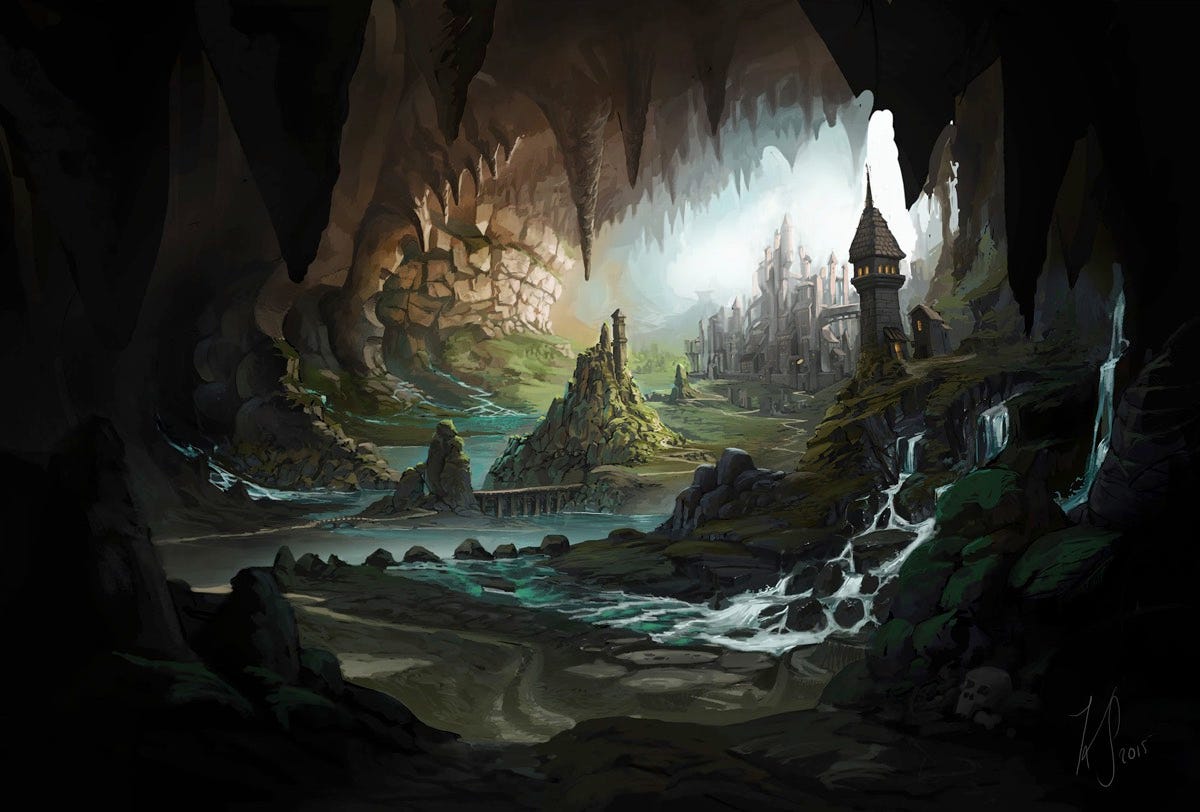
We were amply rewarded for our boldness. Earth, the Great Mother, opened up for us one of her secret treasuries. First we saw a stone ceiling, an immense ceiling whose end we could not fathom as it dissipated in the distance of murky, fragile green light.
We passed an area of stalactites and stalagmites that formed beautiful halls, and some of them looked as if they were made for dwarfs, and the others for giants. We entered a crevice within the rock wall. A magnificent scene appeared beneath our feet.
Had we stepped into a chamber that still preserved the opulence of the Golden Age, or at least memory of it? We beheld a crystal forest, made of monoliths, crystals and the shine of amethysts, emeralds, agate, opal - a forest that came to life under the beams of our torches illuminating our path, revealing itself in a spectrum of colors and trunks that suddenly assumed a phantasmagoric shine. After a long time in darkness, this marvelous play of light blinded us. We felt dizziness and then pain in our eyes.
What geological theory would explain this miracle that entered into our view deep inside the Earth? For what eyes was this spectacle made? Perhaps no human being had set foot in these marvelous chambers for thousands of years.
Closer to the cave wall, a passage opened up through which there appeared to be a path. The path was covered in some kind of crystal dust beneath which were visible miniature crystals and colored pebbles. I noticed one stone with a ruby shine and placed it in my pocket. The wall, however, looked like rock burnt by fire emanating from deep within the Earth, or even the Cosmos. Such fires only burned during the age of the world’s creation. In some places the stone had been transfigured by the flames into glass, while in others it kept the black and gray color of rock.
On the surface of the wall were inscribed letters, 12 in total. They were pressed in or engraved onto the hard surface. I ran my fingertips over them as if trying to curb my disbelief or excitement.
The archaeologist leaned over them, speaking disjointedly about runes, some unknown script, a lost language and an unknown people. Or were they some abstract drawings, incomprehensible symbols from which would emerge, over the course of centuries in some indeterminate proto-historical age, the oldest human script?
“Would you like to know the exact meaning of the inscription?”, I asked Yefremov, not taking my eyes off the inscription. “I have already seen this inscription. They are not runes, but the letters of the Vattan alphabet. The literal meaning is: ‘These are the gates of Agartha.’”
The archaeologist stared at me in disbelief. He thought that what I had just told him was a joke.
“Agartha is an underground world,” I said calmly, "A world inhabited by people or beings very similar to humans in their embodiment, a world that lives its own independent life and of whose existence today’s mankind is unaware. From one explorer of Antarctica I heard a legend of Ningens: beings similar to humans, but of a height up to thirty meters, humanoids who suddenly resurface from the ocean depths only to dive back down again. This is the only comparison worthy of the inhabitants of Agartha. In fact, the Ningen beings also inhabit Agartha. Who, after all, can actually presuppose what secrets the depths of the Earth hold? Agartha still influences all happenings on the surface in its subtle, invisible way, and these influences are sometimes benign, sometimes malign. This hidden centre, the invisible center of humankind, directs the flow of the history of the world.
“Its existence was, until recently, one of the jealously kept secrets of the East. In the interior of the Earth, there are numerous passages dug out, making a unique web that connects lands and continents. They existed even in the Neolithic and, according to many opinions, even much earlier. Some time ago, the entrances were sealed. But even if there were no entrances, the influence of the underground kingdom on humankind on the surface of the Earth would be no less significant.
“Their enigmatic ruler has the power to peer into the mind of every human being. His whisper penetrates men’s consciousness and controls their actions. He is listening to what we are saying here, and he can read our minds.”…
***
READ MORE: The Reawakening of Myth (PRAV Publishing, 2020)
20% discount for subscribers below