
Manufacturing Dissidence: Mamleev on American Exile and the Russian Soul


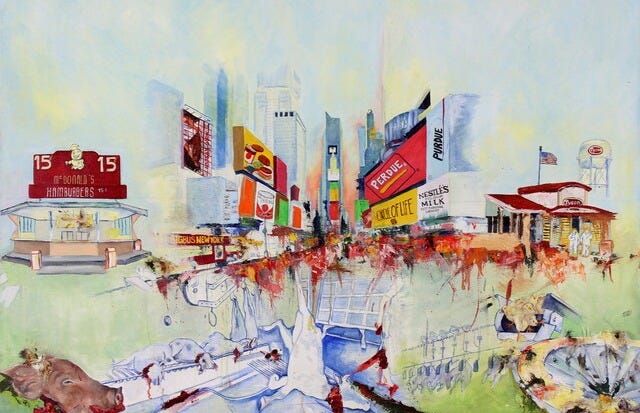
Introduction: The Dissident Industrial Complex and its Discontents
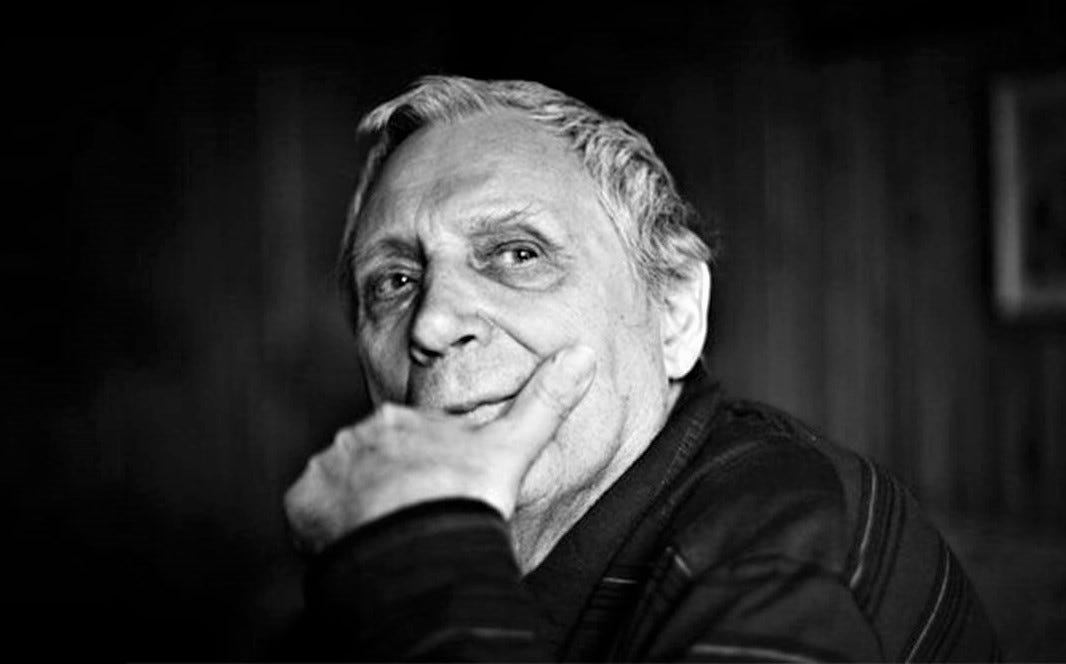
Once upon a time, Yuri Mamleev — the (oc)cult author of the Soviet dissident underground, the visionary of literary “metaphysical realism,” and the founding father of the Yuzhinsky Circle, from which the likes of Alexander Dugin would spring — lived in America.
As Cold War tensions reunite and escalate, the vision animating Yuri Mamleev’s American writings has traveled a swift path from prescient to prophetic. Largely autobiographical, PRAV Publishing’s upcoming volume Mamleev’s America follows the artists and intellectuals who fled the Soviet Union in search of less restrictions on expression and creative life in America, only to find themselves weaponized victims of a totalitarian system far more thoroughgoing in its ambition to adulterate the Russian soul.
Among other matters mundane and metaphysical, Mamleev’s stories chart the architecture of political grooming that awaited Soviet émigrés—from the social pressures to denounce their homeland, to the blacklisting and poverty reserved for those who refused to choose a side, to the quiet erasures of those who chose the wrong one. He reveals the dissident industrial complex in its full insidiousness: a machine for selecting champions by use-value and discarding the leftover dross.
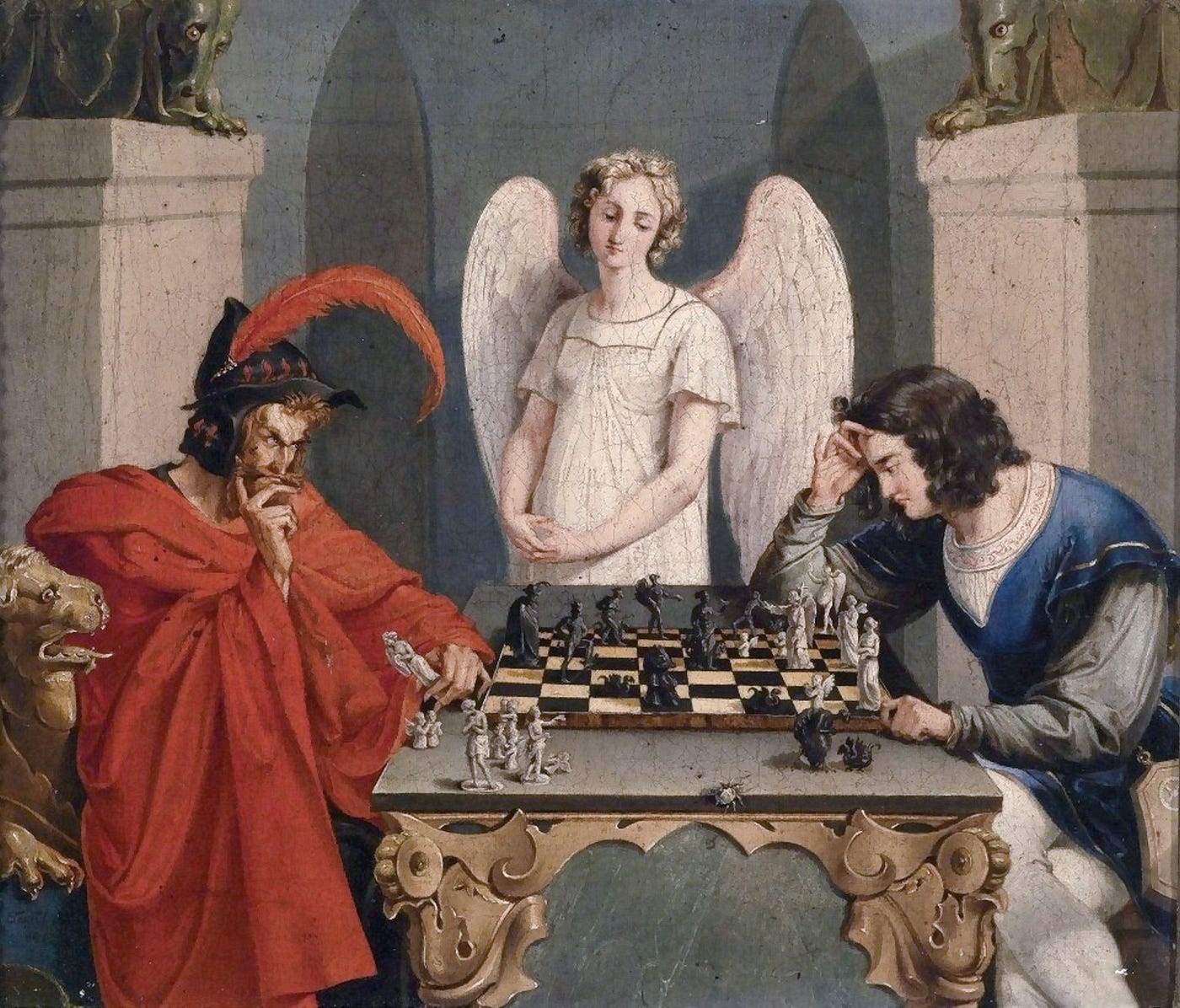
The excerpted scene that follows introduces us to Rudolph — Mamleev’s Mephistopheles — as he initiates Andrei, a Soviet writer fresh off the boat who hopes to keep his art free of any political association. The American Rudolph lays out the rules of engagement in flawless Russian and terrifying clarity: an experiment in truth, a taxonomy of usable dissidence, the stygian depths of surveillance and control. What Andrei encounters is something far beyond the crude coercion of the Soviet Union: he feels the velvet glove of an empire that has already anticipated every possible objection, mapped every faint flicker of resistance, and, discontent with mere political and economic dominance, will not stop until it has annihilated whatever memory of the motherland remains, at home and in exile.
America’s Cold War victory seemingly sealed the global triumph of everything Mamleev warned us about. It was only a matter of time before Washington’s enthronement as the earth’s moral center issued in Epstein’s island, globalized domination, and the forfeiting of any feigned interest in Russian literature. Has the West won? Is there anywhere left to flee, any hope still buried beneath the surface to uncover?Reading Mamleev in this moment is an act of excavation. To read this text is to encounter what Andrei himself discovers when he returns to the classics “as if in a new light”: that Russian literature holds hidden within itself “unimagined submarine currents, entire universe-islands” beyond the comprehension or capacity of any earthly power to destroy.
The dissident industrial complex processes bodies, reputations, careers. It processes vanities, hatreds and ambitions. But it cannot process that which Andrei came to understand as “a consistent feeling of love without end”: a love that “transcends boundaries,” that “departs for such depths within super-consciousness” — such that no empire, however thoroughgoing, has yet devised an instrument capable of plumbing them.
Mamleev does not offer us a program or politics. Rather, he presents us with something far rarer and more valuable: an apprenticeship in perceiving that which forever evades utility and instrumentalization. He invites us to encounter those eternal, divine values whose very existence represents hope for humankind(s), a glimpse of the sovereign, hidden world that hosts them, a world that will one day soon rise from the depths.
— Dr. John Stachelski, PRAV Publishing
Wanderings
excerpted from
Mamleev’s America
translated and edited with an introduction by Charlie Smith
(PRAV Publishing, forthcoming: 2026)
“I’m afraid he’ll make some political proposal to you,” Lena said anxiously. “We should think of a good excuse with a pretext of loyalty. If you refuse in a dumb way, you’ll end up on some black or semi-black list no matter what. I’ve heard that such lists exist. We’ll be permanently unemployed. And, worst of all, you and your books will be barred wherever you go. Why did we even leave Moscow in the first place, if this is how it is?”
“You think it could come to that?”
“It could come to anything.”
She paced sweepingly around their lone room on the hotel’s fifteenth floor.
They wracked their brains for a whole two hours, analyzing all conceivable variants. First, they would reject one solution, then adopt another; but they agreed on one thing: Andrei must not allow himself to be used.
“Come back as soon as you’re done,” Lena admonished him with a kiss.
The exterior of the restaurant had not jumped out at him, but its interior was exquisite.
“Andriusha! Andriusha! Over here!” Rudolph waved from the depths of the salon.
Andrei was struck yet again by the ease with which this man spoke Russian. Later, he learned that Rudolph spoke an additional five or six languages with similar ease.
Their small table for two was set a little out of the way and, as Andrei approached, Rudolph’s face cut itself into his consciousness as it had done before. It was too unusual – his hair was already grey, but the eyes were full of mind and life. Moreover, something in those eyes – in their depths – would occasionally glitter with a malevolence that was not threatening, but unique unto itself.
“As you have already naturally guessed, my friend, I have been to Moscow many times,” Rudolph began. “And, by the way, I’ve read your works in samizdat. They’re not in accord with my spirit, but they’re good. In my view, they don’t contain enough cruelty. Don’t forget, we’re in the twentieth century. But what’s most important is that you have talent – great talent, which is not to be denied. There’s a certain treasure in your work over which you have absolute command and which can be utilized in a number of ways. Am I right?”
And so it begins, Andrei thought.
He was under such strain that the gourmet food arrayed before him had utterly escaped his notice. Rudolph caught onto this. He made a light gesture of the hand.
“Never mind. Relax. I know perfectly well what you’re thinking,” he said, looking directly into Andrei’s face. “But you are wrong, my dear friend. Our conversation will concern an entirely different subject and, more importantly, it will go in a different direction. I think you’ll find this a very pleasant subject. The topic of conversation is Russia.”
“Russia?”
“Yes, why do you ask? Surely you don’t think you can convince me that you don’t love your country?”
“But…”
“Let’s do without the ‘but.’ Judging from no more than your reactions to certain observations made at our party yesterday, only an idiot could fail to realize how you feel about Russia. Never mind that we only talked about your country’s past, about Ivan the Terrible. Yes, judging from some of your wife’s remarks, as well as your own, it is plain to see that mother Rus’ is still very much alive… What’s more, you were trying not to give yourself away,” Rudolph let out a burst of visceral laughter and took a draught of wine. “Fine – let us speak with extreme friendliness and extreme candor. It is clear why you left Russia and what it is that you love. As for me: partially, in coordination with others, I am proposing the foundation of an institute dedicated to the study of Russia – not just the Soviet Union or the Russian Soviet Federative Socialist Republic, but the Russia of the past, Russia in Her entirety, and even Russia as She will be in the future. I would like to have this conversation with you, specifically. Just trust me to begin with, and you’ll come to understand what I am saying eventually. At my own risk, I would like to conduct a psychological experiment. Do you consent?”
Andrei was so stricken by the strangeness of what had been said, along with the slightly obscure humor of the strange man, that he nodded his head almost mechanically. However, the tension in him remained.
“Well, that’s fantastic. But let me begin, if you don’t mind, with some theory and philosophy. After all, everything serious always begins with philosophy, don’t you agree?”
Rudolph took another easy and non-committal sip of wine.
“I am going to reveal an American secret to you,” he continued. “It has to do with scientific research… Admit it, my friend, you were expecting something else, fearing that I’d be prying secrets out of you? But everything is turning out to the contrary… Funny, isn’t it?”
And Rudolph once more released a bout of braying, visceral laughter – a very healthy laughter.
“This research had to do with life and the psychology of nations. Questions as to why some peoples survive while others perish, and so on. And do you know what we observed? We naturally found that there are various complexes of causes, but the main and decisive cause of a nation’s survival is its love for itself, for its culture, for its spirit. If this love doesn’t exist, the people perish and are assimilated. But if this love does exist, the people usually survive, provided an absence of catastrophic external circumstances. And if this love is present to the highest possible degree, the people become a great people, and may thereafter play a major role in world history. It is difficult to annihilate such a people as a rule… As you know, you Russians feel this kind of love for yourselves. I would even go as far as to say that Russians’ love for Russia – as is apparent in your literature, history, and psychology, both past and ongoing – is astounding and unique. But, first of all, it is quite a mystery for us western people; and, secondly, it is the mightiest weapon with which you have survived throughout history. I’ll say one more thing: without such a love, you would have perished long ago, and nothing – neither your powerful language, nor Moscow, nor you yourselves – would remain…”
Andrei became suddenly furious (his paralysis had passed, and now he felt a sort of hostility).
“I don’t suppose you’d like to know my opinion, my reason for why I love?”
Rudolph bellowed with such violent laughter that his head whipped back so that he was facing the ceiling.
“My friend, if you Russians knew why you loved, we – your enemies – would know your reasons, too. And it’s easier to resolve any investigation once you know the reasons behind the object of study. But the fact is that these reasons are highly difficult to learn, including for the bearers of this love. A love like that is like a little brick of primordial being – like a first foundation – and that sort of thing is often ineffable. And yet we, as true western people, are analysts and empiricists; we loathe all forms of mysticism, diligently analyzing you, calculating the whole of your great literature with our computers, digging around in your history, religion, and psychology, the diaries of your great people, even in your love letters; and notice that we do this all with the help of the latest in technology and psychoanalysis. We are well aware of your weaknesses and strengths. We have surveyed thousands of Germans about you, and the results of these surveys are kept in computer memory. We understand almost everything, save one factor: your love. The mystery of your patriotism is an unknown for us.
“Why am I saying all of this? We know all the facts, but not the reason. If you knew the reasons for such phenomena, we would then find a way to annihilate them. We would deprive you of your most terrible and inexplicable weapon. And then we would get our bare hands on you. Without any wars. And you wouldn’t even notice how you had become our colony – politically, economically, ideologically, culturally, and spiritually. And then we’d have settled our score with you once and for all. In order to take you, we’d set out a thousand different traps, and you would almost certainly fall into several of them. Oh, you don’t even realize just what sublime methods exist,” Rudolph made a cold, indifferent gesture with his hand. “But, alas, none of this works unless your love either declines or disappears. You’re weaving a thread; it would seem that you’re conducting yourself in just such a way… And suddenly, with a single movement, everything is dissolved. All of your efforts fly off into the abyss…”
“Why are you telling me this?”
“Andrei, we agreed upon this experiment, did we not? Hear me out calmly. Of course, we are trying to feel out an empirical means, so to speak, of waging strikes against your love. Ways if not of breaking, then at least somehow of destabilizing your patriotism…”
“And how’s it going? I’m curious.”
“Well, you see, there are a number of methods,” Rudolph said with an even, benevolent wave of the hand as he lit a cigarette. “Let’s say on the mental or emotional plane. With the help of radio, the émigré newspapers, and all the rest. There are various means, many of which you don’t even suspect. Of course, I am not speaking of the senseless, raving defamation of your history, culture, and faith. That’s the black work. But there are also subtler methods: skepticism, irony, veiled sarcasm, sympathy, games of semi-truth, and even total truth (the truth, itself, can become a lie if you know how to apply it). Then there’s the unnoticed substitution of values, slight, covert digs at everything great and sacred, whether historical, cultural, or religious. This is done in order to shake a people’s love for these things. To enable you to laugh at them all in secret – to make you think that such a thing is possible. Or, to take one example, by discreetly using the difficult moments of your history – with a sympathetic smile on our faces – to foment within you a hatred of yourselves. A repulsion. This is all aimed at developing, ever so slightly, a feeling of guilt in the victim, heh heh… To pervert and invert everything. To set one against another. To create a schism and inflame conflicts. The aim is to take a positive phenomenon such as self-criticism and to drive it to the point of absurdity, where it achieves a negative state. To shear the intelligentsia off of their national foundations. Oh, modern covert propaganda – how astonishing it is! Not for me, naturally,” Rudolph laughed. “In a nutshell, these methods are all designed to paralyze from within.
“Ultimately, these parlor tricks are more clever than they are effective, according to the opinions of certain specialists in the secret psychological war. All of these tactics can indeed work, provided the love of which I spoke earlier is not present. Otherwise, even if the opponent does not realize what snares are being laid for him, he instinctually resists all hidden pressures. And, oftentimes, these pressures provoke a counterreaction. It’s not so hard to guess why. All it takes is a modicum of desire, and the boomerang effect is unavoidable.”
A thousand thoughts and feelings passed through Andrei’s soul while Rudolph Bach spoke. But he had elected to remain silent on the surface or, at the very least, to speak as little as possible. Well here you are now, sitting one on one with Mephistopheles, he concluded to himself. But he found it uncomfortable to stay silent, suddenly speaking out:
“It turns out that you know about my work in Moscow. But I didn’t come here all by myself; there are a few of us surrealists here from the USSR. We are seeking aid from American cultural funds, now that we’ve organized our literary group of ‘Independents.’”
Rudolph chuckled.
“You’re just killing me with your remarks today. But that’s a serious conversation… ‘Independents.’ You couldn’t come up with something less provocative? In a world where everything depends on the almighty dollar – ‘Independents’! People will think of you either as children or as arrogant cynics and smart-mouths! I don’t wish to cause you pain, Andrei, but this venture of yours will yield no fruit. Sooner or later, you’ll see that for yourself. You’d better prepare for that.”
“Strange. There’s so much money in America. What would it cost to start a magazine..?”
“A lot of money! Depending on whose money it is and what it’s for. You’ve hit on an interesting topic. What are we to do with your dissidents? It’s a curious issue. Naturally, there is a great deal of money in America, but keep in mind the millions – the tens of millions – who are living like animals. They’re in the ghettos, on welfare which is doled out for no other reason than that, otherwise, the recipients would go out stabbing and shooting anything and everything in their path. They’ve got nothing to lose. I’m not even talking about the unemployed – they’re practically elites in comparison to this sea of untouchables. But we’ll fund the dissidents. Not all of them, but many of them.”
“Do you want to use them?”
“My dear Andrei, what else are they for? But we’ll take different approaches in doing so, keeping certain categories in mind:
“The first category contains people like you. Artistic non-conformists. Not political dissidents. We couldn’t care less for those types, and for an entirely rational and respectable reason. The preservation of Russian culture and literature doesn’t figure anywhere into our plans. So let them wallow over here all they want – we’ve got enough unpleasantries as it is.

“The second category contains martyrs and fighters, often fresh out of the jails. These types are so consumed with hatred that they’re prepared to bomb their own hometowns. They’re fanatics, in a word. Amusing material. It is quite easy to manipulate them. But you’ve got to keep them on a short leash; hatred is a terrible force that must be controlled.
“The third category contains warriors for justice. Sincere idiots, which is to say idealists. They’re the easiest of all to manipulate. Unfortunately, these types are almost always mediocrities, with rare exceptions. Their efforts are all in service of the ‘truth.’ But, since we know how to turn the truth into a lie, this category is exceedingly convenient for us. You can pay them mere pennies to do your bidding. We don’t trust ideas – people’s convictions are subject to change. We ourselves have no ideas, besides that of egoism. We only believe in those who will either serve or betray for money. That’s our pathos. The main problem for the third category is the competition that goes on in it; no matter what, the most important thing to them is ‘breaking out into the world,’ as you people like to say. But breaking out is not so simple. Just imagine it – soldiers who die in the name of ‘egoism.’”
Andrei was yet again stricken by Rudolph’s skill with Russian intonation, juxtaposed as it was with his “un-Russianness.”
“The fourth category contains the writers,” Mephistopheles continued. “Pardon me, the dissident writers. They’ve got too many individual particularities. Alas, money isn’t always a trump card with them. Although, between us, it’s a substantial one. Even so, what drives them more than anything else is vanity. You understand, my dear Andrei, that this is simply an ace in our hand. The only danger these types pose is massive talent.”
For the first time throughout the conversation, Andrei broke into laughter.
“Because, then, everything else falls away – even the vanity. We don’t need talent as such, just a touch of talent. A tiny speck of it. Thank God that the overwhelming majority of them are like that. Everything’s simpler that way. The free press for hire will write whatever we ask. A mediocre talent will transform into a regular synthesis of Tolstoy, Dante, and Pushkin. The paper can bear anything. Vanity turns them into simpletons. And then all we have to do is tug on the strings. It’s an elementary machine. But we pay a lot for it.
“The fifth category is the most neutral. It covers everyone who, on the true, subconscious level, works either for money or for us, while convincing himself on the conscious level that he’s working for ‘justice’ and ‘truth.’ They’re easy to deal with. We pay them a low-to-middling sum.”
“Finally, the sixth category contains those who work for ‘us’ directly. They believe that they are, in any case. But the real question is who ‘we’ are, after all?”
And then Rudolph gave Andrei such a magnificent wink that the latter lost all patience and did not even know what to say. He gathered himself and responded.
“Who ‘you’ are is for you to say. As far as I’m concerned, I don’t understand a word you’ve just said to me. Of course, one could follow many in saying that America is the dictatorship of the rich, the banks, and big business… But even a child knows that. Democracy and freedom are just a circus for the weak-minded. That’s plain for me to see.”
“Naturally, it is just as you say,” Rudolph grinned. “But I was speaking of something more profound, something unearthly… You’re not being entirely sincere with me, my friend. Unlike I am with you.”
“Well,” Andrei gasped. “Your kind of sincerity carries the chill of hell. May God deliver me from it.”
He downed an entire glass of wine and continued.
“Besides, I haven’t forgotten that what’s happening here is an experiment. You’ve said so yourself.”
“Oh, yes. Not in the sense of a lie. It’s an experiment in truth. It is, indeed, the most horrifying experiment one could imagine. The rarest, to boot. We’d better stop halfway and have a drink, eh?”
“Let’s.”
They drank. They were silent.
“What other categories are there?” Andrei asked.
“Ah,” Rudolph muttered, suddenly waving his hand in disgust. “There are others, of course. But our general principle is like this: speaking symbolically, let’s say that our enemy or, excuse me, our planetary neighbor is experiencing a forest fire. This is happening in some specific region. And this is the truth. But we need to use that truth – not in order to put out the fire, but to annihilate our neighbor. Sometimes, we get good use out of the truth-seekers living in that neighbor’s territory. But that’s just one level. There are even more terrible levels,” he added in a rather dry voice.
“But you don’t suppose that someone among these dissidents will emerge who will call for a revolt against you?” Andrei suddenly asked, having utterly lost control internally, but not externally.
Then Rudolph, as paradoxical as it might seem, broke out once more into chuckling laughter.
READ MORE:
“Andriusha, let’s grant that a few among them will understand every subtlety, will gnash their teeth, will even burst into tears – they will nonetheless do what we require of them. The fact is that such a revolt would even be useful to us. True, we tend to make more use of such action in relation to our intellectual class. Naturally, we’re talking about a controlled revolt. We know how to control everything. The balances in the bank accounts of our 1960s “rebels” aren’t too shabby. But most important of all is psychology. Occasionally, you have to allow people to whine at their masters. It works like an outlet. The CIA even cooks up rumors about the CIA.”
“Oh, the CIA! Some of our émigrés think that they’re quite a humanist organization.”
“Without a doubt. Christ, Buddha, Albert Schweitzer, and Romain Rolland should follow their example in this regard. But your friends – your émigrés – have gone too far. I will speak frankly with you,” Rudolph said, pausing to order a coffee. “You see what a sweet paradox this all is: I am revealing government secrets to you without asking for anything in return. The FBI is swamped with reports from Soviet emigres who are informing on one another. Simple people – good guys from Odessa, as you put it – don’t do such things. It is primarily intellectuals and those fighting for human rights who are submitting the reports. Given my position, I am able to read them; and though they are insignificant, chump change, I read them because they are interesting on a psychological level. I’ll admit it, I envy you. There was a time when I myself dreamed of becoming a writer. And if one were to take all of these reports and compile them into a book, even just a fraction of them, he’d end up with the novel of the century. I would even go so far as to call it the novel of the twenty-first century. But, alas, you have no possibility of making off with them. And the style, Andriusha, what style they have… for the aesthetes of the future, this material is unsurpassed…” Rudolph’s eyes rolled back in his head. “What seething rage! And the subsequent life consequences tend to be tragic. This, if you will excuse me, is more than mere literature.”
Krugov’s eyes widened.
“I hope there are no reports on me.”
“You would be mistaken, my dear friend. Where you’re concerned – despite the fact that you’ve only been here for two months – there exist entire folders of such compositions. Within those pages, you are naturally a ‘Soviet agent,’ an ‘informant for hire,’ a ‘potential sadist,’ while your wife… it’s even terrible to speak it aloud… is a ‘national chauvinist.’ It turns out that your friends Kegeyan and Rostovtsev were celebrating International Women’s Day. I never would have expected it from them. There’s an ocean of reports where they’re concerned. After all, it’s a Soviet holiday, even if it celebrates women. And then there’s one fellow who was reading Esenin in a club and insisting that he was a great poet. One hesitates to speak of him. It’s frightening even to say how much has been written about him. You see, the greatest pillars of your culture have become a substantial basis for reports. Hitler, hated as he is by all, was far more human than us. If I am not mistaken, people were still allowed to read Esenin during the German occupation.”
Rudolph’s disquieting smile and nearly motionless eyes finally sent Andrei over the edge:
“There’s no way! It’s just not possible!” he said with a sort of passion. “You’re trying to provoke me!”
“Such is the eternal insult hurled at those who speak the truth,” Rudolph said through a fit of laughter. “Take courage, my friend. Lying ahead of you is something of which you have never even dreamed. Take courage.”
“What made you choose me for your experiment?”
“Whom should I have chosen? I, myself, don’t know. Maybe it’s because you are a talented man, a true writer. I don’t waste my time with shit.”
“And yet,” Andrei said after a brief pause, “you’ll find among those political writers, as you call them, certain unpredictable figures, and they’ll stir up a revolt. They’ll come out from under your control.”
“That’s not out of the question,” Rudolph answered seriously. “But it is very unlikely. In matters of such great importance, people tend not to pay attention to such a high level of risk. Besides, you are underestimating our system of freedom,” irony slid across his lips, “and our understanding of man’s lower nature.”
System of freedom? Incredible, Andrei thought to himself.
Then he asked aloud, “Fine, what do you want from me?”
“Nothing.”
“What do you mean, nothing?”
“Andrei, first of all, I am speaking to you sincerely. Within the bounds of this conversation, I do not speak for those whom I serve, but for myself. This experiment is not in service of my institution, but for my own personal benefit.”
Rudolph lit up a cigarette over his dessert, which had clearly not met his expectations; piquant food was more to his taste.
“The fact is, I took an interest in you while you were still in Moscow, on the basis of your writings,” he continued. “I have the right to free inquiry. A person like you would undoubtedly come to the same conclusion as I have. But such a conclusion would have occupied a great deal of your time before revealing itself. Maybe something that I will say or have already said in passing would never have entered your mind. In any case, I have chosen to express much in an immediate way, to deafen and shock you in order to see your reaction. To see what ultimately will become of you.”
“Why is that so important to you?”
Rudolph sighed.
“It’s all for the sake of art, Andrei. All for the sake of art. And things will become apparent in art. Of course, you will feel compelled to ‘verify’ my theses, if you will permit me to use such language. They will be difficult for you to accept immediately. It’s to be expected. You’ve just arrived. You’ve had a bad go of things. In some sense, you remain full of hope. I completely understand why it is difficult for you to believe that heaven is hell. Not only is there no heaven to speak of, but all you are doing is transitioning from one form of hell to another. That’s all there is to it. You simply have yet to comprehend this fact and, in the interim, it’s possible to take a small breather. But it will be difficult for you here, far more difficult, my friend… Allow me to give you a little advice: while you are ‘verifying’ what I say, be sure to pay careful attention to our major newspapers. As your people say, read between the lines. You will quickly come to recognize the machinery of ‘democracy’ and ‘freedom.’ It doesn’t contain any particularly complex parts. ‘And those are all the pirozhki,’ isn’t that how you say it?”
Rudolph rubbed his hands together.
“So you’ll be observing me, I take it?”
“Observing you? You’re already being observed, my friend. Every one of you who has come to this country is under surveillance. Be thankful that one of your ‘observers’ is also your benefactor. For I wish you nothing but good, if only such good could be said to exist,” Rudolph said with a somewhat exultant air.
“Yes. My manuscript, which I sent through an American diplomat, found its way to a certain well-regarded professor. That’s what another of my admirers from the FBI or CIA told me… I was stunned – why dig around in texts which I, myself, fully intend to publish? They combed over that manuscript as though it were something underground and encoded. What could they have found there? After all, it was nothing but pure art, having nothing to do with politics. Just a few essays about death and nature!”
“It was perhaps precisely the lack of politics that caused some to be taken aback… And later, there might be much else to discover. My friend, you are still quite naïve and do not appreciate the full scope of our investigations into the Russian man. You are being carefully observed, and you don’t even suspect the vantage from which such observation is taking place. You are already under a microscope. Admittedly, as I’ve already said, the microscope is less than perfect. It is incapable of picking up a certain detail of crucial importance, an entire abyss. And Big Brother doesn’t just see émigrés. He sees everyone who lives here. Sleep and remember our freedom: Big Brother is always watching you.”
“So we’re talking Orwell, are we?”
“What Orwell? Orwell was no more than a child. Search more deeply.”
Andrei felt somehow unimportant. An almost physical weight settled upon his heart as though someone were touching it.
They spoke a little longer. Rudolph paid the check.
“I’m paying with my own money, Andrei,” he smiled. “In the future when you are treated to lunch on the occasion of some semi-official meeting, remember that it is usually not the person who invited you who is paying, but the organization to which he belongs – a university or even the FBI, if such a measure should prove necessary. But I am personally paying for your lunch.”
“And this conversation – is it just between us?”
“Naturally. Not out of fear for you, but for the sake of the experiment’s purity. You’ll tell your wife, of course, but don’t tell her in your hotel room. Do so while walking down the street, preferably in a crowd. I highly suggest that you refrain from telling anyone else. Bear this weight on your own. I’ll give you a call before too long, but not right away. We will meet a second time. And that meeting will be of equally fundamental importance. In the meantime, much will have changed for you. No matter where you end up living, I’ll find you for the sake of that second meeting. I will know what is going on in your life.”
And the two parted…
Mamleev’s America is coming soon from PRAV Publishing

READ MORE… this time from America:
Readers interested in dissidence, self-discipline, and intellectual independence in the modern era should check out the PRAV Perspectives interview with Alexander Ford and Jack Parnell, discussing their book A Slow Death or, The Silence of the Old World (PRAV Publishing, 2024).