
Counter-Initiation: Critical Remarks on Some Aspects of the Doctrine of René Guénon
by Alexander Dugin


From the archives:
Signed as written in 1997, this essay was originally published in Russian in Konets Sveta: Eskhatologiia i traditsiia [The End of the World: Eschatology and Tradition] (Moscow: Arktogeia, 1997/1998) — which some bibliographies refer to as issue no. 3 of the journal Mily Angel [Sweet Angel] — and was then revised and republished as an appendix to the second edition of the book Puti Absoliuta (The Ways of the Absolute) in the three-book volume Absoliutnaia Rodina [Absolute Homeland] (Moscow: Arktogeia, 1999).
This first English translation, which appeared on Eurasianist Internet Archive in 2019, has been comprehensively revised by Jafe Arnold especially for PRAV Perspectives.
Preliminary Remarks: The Necessity of Correcting Traditionalism
The question of “counter-initiation” is the most shrouded and ambiguous in all of Traditionalist thought. Perhaps this is a consequence of the very reality which Traditionalists, following Guénon, usually denote with the term “counter-initiation.”The meaning of counter-initiation is set out by René Guénon in his book The Reign of Quantity and the Signs of the Times.1
In brief, we can say that Guénon understands counter-initiation to be a whole set of secret organizations which, although in possession of initiatic and esoteric data, nonetheless direct their activities and efforts towards a goal which is the direct opposite of normal initiation, i.e., not towards attaining the absolute, but towards fatal disappearance and dissolution amidst the “reign of quantity” in its external twilight. In line with Islamic esotericism, Guénon called the hierarchs of counter-initiation Awliya es-Shaytan, that is to say the “saints of Satan.” From Guénon’s point of view, representatives of counter-initiation stand behind all the negative tendencies of modern civilization and are secretly steering the course of affairs down the path of degradation, materialization, and spiritual degeneration.
Since, according to Tradition, the logic of the cyclical process inevitably boils down to a path of degradation, from the Golden Age to the Iron Age. it follows that there should be certain conscious forces contributing to this process just as, conversely, the forces of true initiation and genuine esotericism try to impede this fatal decline by all means. This historical dualism of Guénon’s in no way affects the metaphysical unity of the Principle, insofar as it belongs to the sphere of manifestation, where the main law is that of duality. This duality at the very heart of manifestation is overcome only upon going beyond the manifest into the sphere of the transcendental. Within the world, dualism is indelible. Thus, the role of counter-initiation is partly justified, since it is rooted not in arbitrariness, but in the very providential necessity tied to the laws of the cosmos.
This purely theoretical aspect of the doctrine of counter-initiation is completely flawless from a logical point of view and is confirmed by the various doctrines of sacred traditions which deal with “demons”, “the devil”, “evil spirits”, the “Antichrist”, etc. But everything becomes much more complicated when we attempt to move from theory to practice and name specific organizations or secret societies as examples of counter-initiation. This is only part of the problem. Before we can clarify this subtle question, it is necessary to more attentively examine what René Guénon meant by “initiation” and “esotericism.”
According to Guénon, the historical differences between sacred forms — religions, traditions, etc. — is a consequence of the differing qualities of the human and historical environments into which the rays of the One Non-Human Truth are projected. In other words, for Guénon, all traditions, as one approaches their center, transcend confessional differences and almost merge into something singular. Guénon called this the “Primordial Tradition” (la Tradition Primordiale). This Tradition, according to Guénon, constitutes the secret essence of all religions. In a certain sense, this is right. Careful study of the symbolism of Tradition, its rituals and doctrines, leads one to the thought that all sacred teachings have a certain common element or paradigm which is somewhat lost sight of when one arrives at more narrow dogmatic aspects and matters of detail. The thesis of the “unity of Tradition” is particularly convincing in current circumstances, as the modern world has created a civilization whose very foundation strikingly contrasts with everything that might be called Tradition. In other words, Integral Traditionalism and appealing to the One Tradition are credible to the extent that the modern world is opposed to all those civilizational forms that are founded on sacred principles. Indeed, there are many more similarities than differences between the various traditions and religions when compared to the generally contrasting backdrop of modern, completely desacralized civilization. This postulate is obvious. The question is: to what extent is this convergence in the face of a common enemy a consequence of esoteric unity?
In other words, are the differences between sacred traditions themselves merely the result of faults in the cosmic environment at certain moments in the cycle? Are there not some deeper reasons behind this?
One glaring example of the relevance of such doubt can be seen in Guénon’s hesitation as to whether Buddhism should be counted an authentic tradition or not. Guénon initially relegated Buddhism to the category of antinomian heresies, but later recognized it to be a genuine tradition. The matter at hand is not even about Buddhism, but the fact that such uncertainty on Guénon’s part exhibits a certain conditionality of his method whenever the matter at hand concerns concrete historical traditions and their dogmatic principles. If even Guénon could be mistaken on the question of Buddhism (which for him remained largely an abstraction, for the analysis of which Guénon relied on the opinions of Hindu informants who, like all Hindu Traditionalists, are distinguished by their acutely anti-Buddhist orientation2) then it cannot be excluded that such errors may occur in the case of other religions as well.
Our own studies have led us to the conclusion that Guénon’s assessment was not quite right in at least two other cases.
First, when Guénon denied the Christian Church an initiatic dimension — and he dated the loss of this dimension (present in early Christianity) to the era of the first Ecumenical Councils – he was clearly relying exclusively on the history and historiosophy of the Catholic branch (with the later deviation of Protestantism). Guénon clearly ignored the metaphysical and initiatic reality of Orthodoxy, which differs from Western Christianity sharply on the most fundamental positions. Guénon equated Christianity with Catholicism and inappropriately projected the proportions of the Catholic organization — including the mystical nature of its rituals and theological specificities — onto Christianity as a whole. This rendered his views on the matter completely incorrect.3
Second, Guénon hastily recognized Jewish Kabbalah to bear the quality of genuine esotericism — which, in his opinion, is distinguished by universalism and is beyond any particularisms. But in fact, Kabbalah insists on the ethnic specialness of Jews, the uniqueness of their fate, and their metaphysical antagonism towards all other peoples and religions. This clearly contradicts Guénon’s definition of esotericism, according to which the principles of universal unity should predominate and all spiritual and religious forms merge into a common concept. Even in its most transcendent aspects, Kabbalah affirms not unity, but a radical and indelible metaphysico-ethnic dualism.
Furthermore, on a more general plane, Guénon’s assessments of certain peoples — such as the ancient Greeks, the Japanese, the Germans, the Anglo-Saxons, and the Slavs — were at times so subjective and arbitrary (and at times Guénon even endeavors to base some of his conclusions as to the orthodoxy or non-orthodoxy of various traditional forms on these appraisals) that all the aspects of Traditionalism which pertain to the application of theoretical considerations to the practical sphere become questionable.
The Absence of Universal Counter-Initiation
The differences between religious forms can be far more of a profound factor than the conditionalities of exotericism, and can be rooted in metaphysics itself. If for Hinduism and Islamic esotericism, by virtue of the specificity of these traditions, a unifying synthesis can be accomplished rather easily (all other traditions are interpreted in terms exclusively peculiar to them), then the matter stands somewhat differently with other religious forms. Hinduism and Islam allowed Guénon to construct a logical and non-contradictory picture, but one which becomes less obvious when we attempt to apply it to different religions and their specific approaches to metaphysics.
For Guénon (and the Traditionalists who follow him), the situation is thus: the One Metaphysical Tradition, which constitutes the essence of universal esotericism, is the inner kernel of all orthodox traditions. Dogmatic religions and other forms of exoteric traditions are external shells covering this unity of content (esotericism and initiation) in diverse ways. On the pole opposite of universal esotericism is “counter-initiation”, which is not simply the rejection of this or that religious or exoteric form, but of this universalism as such. Thus, the very concept of “counter-initiation” is inseparable from postulating the esoteric unity of all traditions.
However, outside of esoteric Islamic and Hindu contexts, such logic cannot be accepted unequivocally, since the metaphysics of other traditions do not recognize any esoteric solidarity with other religious forms. In fact, the universalism of Sufism and Hinduism is not as obvious as it may seem at first glance. The price of recognizing the orthodoxy of other religious forms is paid by asserting their “distortedness” and treating their dogma in the spirit and letter of the specific esotericism peculiar to Hinduism and Sufism. For example, the Hindu approach to Christology practically equates Christ to an avatar, which, in a strictly Christian dogmatic framework, is equivalent to the “monophysite” view. Islam, on the contrary, proceeding from a strict monotheism, adheres to a “Nestorian” (“Arian”) Christological schema. In both cases, the Orthodox Christian formula which ultimately leads to its own, altogether different metaphysical perspective is denied.4
Thus, the universalism proclaimed by Traditionalists turns out to be not so total and unambiguous as one would like.
Furthermore, Hinduism bases its tradition on a formula that is inverse to that of the Iranian tradition, which is derived from the same source. As is well known, even in the very names for gods and demons, there is an inverse analogy between Zoroastrianism and Hinduism. Moreover, Hinduism considers Buddhism to be a heterodoxy (a view to which Guénon himself adhered for quite a long time). As follows, these three Eastern Indo-European traditions cannot come to an agreement amongst themselves and establish esoteric unity without raising certain issues. Indeed, it is quite difficult to recognize any “esoteric rightness” on the part of those who call one’s gods “demons” and vice versa (the Devas and Asuras in Hinduism and Zoroastrianism signify directly contradictory principles) or who radically deny the authority of one’s foremost sacred source (as Buddhists reject the Vedas, castes, and all the foundational doctrines of Hinduism).
The situation is even more severe in the Abrahamic context. If Islam recognizes some kind of legitimacy for the traditions of the “peoples of the Book” (Judaism and Christianity) and believes Muhammad’s mission to be the last word of “Abrahamism” which corrected all previous errors, then neither Christians nor Jews recognize even the slightest authenticity of other versions of Abrahamism, which are considered heresies, lies, and evil.5 The example of the Zohar, the highest authority of Kabbalah, easily lends to the conviction that hostility towards Islam and Christianity is not only not removed on the metaphysical and esoteric level, but, to the contrary, attains the highest metaphysical intensity.6 Accordingly, fully-fledged Orthodox esotericism treats Judaism (both exoteric and esoteric) just as harshly, seeing it not only as an otherness of external religious form, but as the embodiment of metaphysical evil and the “tradition” of the Antichrist.
Thus, beyond Sufism and Hinduism (whose universalism is also not unlimited), there is no common esotericism, and this means that traditions understand “counter-initiation” to be those sacred forms which openly contradict their own metaphysics. In this case, if the exoteric evil is represented by the negative points stemming from the ethico-dogmatic specifics of a given religion, then the esoteric evil (counter-initiation) would be the metaphysics of the other tradition that contradicts such.
All of this incredibly complicates the question of counter-initiation, which ceases to be so obvious and transparent, and instead becomes extremely convoluted.
From the point of view of Orthodox esotericism, Judaism and Kabbalah are undoubtedly the counter-initiation.7 From the Zohar’s point of view, the esotericism of the goyim, especially the “descendants of Ishmael and Esau” (Muslims and Christians), is “the false teaching of the demon Samael” who “rides the serpent Lilith.” From the point of view of Hindu esotericism, Iranian dualism is rooted in the fact that Zoroastrians worship demons, the Asuras, (Iranian Ahuras), whom they call “gods.” Buddhist esotericists are convinced that the initiatic doctrines of Hinduism are the ultimate evil, insofar as they only increase the attachment of beings to samsara — after all, the higher divine worlds are distinguished in the Buddhist perspective by an even greater illusory quality than the worlds of humans, as the absence of suffering only alienates the prospect of achieving nirvana. In Islamic civilization, the most radical representatives of manifestationist esotericism — such as al-Hallaj, Suhrawardi, etc. — were executed as malicious heretics.
How, in such a situation, can one discern any universal counter-initiation, trace its origins, and recognize the forces and organizations serving as its cover? If the universality of esotericism (in the very least, in our cyclical situation) is not obvious and proven, then how can we speak of any universality of “counter-initiation” being the inverse projection of such?
Inter- and Intra-Religious Contradictions
There are deep contradictions between traditional religious systems which can be traced back to the higher realms of metaphysics. On the other hand, these traditional forms are not immutable, but are subject to cyclical laws. Traditions pass through difficult periods of historical embodiment, among which, besides the natural stages of efflorescence and fall, there are even more paradoxical moments, such as changes in their internal nature, alienation, and transformation into something essentially different while maintaining their external attributes.
More often than not, these disturbing moments cannot be reduced to some “triumph of negative tendencies” as viewed by the exoteric tradition and morality derived from the letter of given sacred forms. For example, the Islamic tradition can degenerate without its authorities publicly denying the principle of monotheism or the mission of Muhammad, and Christians by no means need to worship other gods (or Satan) in order to break with the source and spirit of the Church. If everything were so simple, history would be an elementary, mechanical device with predictable functioning and an easily foreseen future. In fact, this is how many things are seen by those who are distinguished by a naive (if not to say idiotic) view of the world, no matter whether they are “conservatives” or “progressives.” Only a deep understanding of the internal kernel of tradition, the actual realization of its higher levels, allows us to distinguish and grasp what is foremost and most essential, and that means accurately differentiating the true axis of orthodoxy from alienation, deviation, simulation, degeneration. There are no purely external criteria to this question. One should not overestimate the “devil” — if he were as simple as moralists think, he would hardly have been able to participate in human history so actively, for so long, and, most importantly, without be recognized.
For example, the schism of the Christian world into the Eastern and Western Churches was far from a purely exoteric event: behind the schism lurk the most profound metaphysical reasons.8 The same is true for the Islamic world and the division into Shiites and Sunnis. The Sunni tradition (especially Wahhabism) believes in the high authority of Sultan Yazid, who killed Ali, Muhammad’s cousin, who is the spiritual pole (qutb) for Shiites, the first Imam. Behind this contradiction lie much deeper divergences of a purely metaphysical nature.
In some sense, things are no smoother in the case of Hinduism, in which Vaishnavism and Shaivism are not in such harmony with each other as might appear to be the case at first glance. For example, the traces of such a dualism can be seen in the Mahabharata, whose editing was, without a doubt, the work of Vaishnava circles. The Kauravas, the enemies of the Pandavas and the inveterate villains, are portrayed as inspired by Shiva and his retinue to the point that Shiva is considered to be a “subtle essence” in contrast to the metaphysical and purely spiritual nature of Krishna, the avatar of Vishnu. The parallel with the “devil” begs itself in this case, especially if we take into consideration Guénon’s indication that the “devil” belongs to the “subtle plane.”9
If we apply the Traditionalist approach to other sacred forms beyond Hinduism and Sufism, we land in a situation in which it becomes impossible to speak of counter-initiation as something universal and opposed to universal esotericism without falling into mythomania or moralistic dualism (which, theoretically, should have been overcome insofar as we are considering the sphere of esotericism). In other words, every sacred form in possession of its own metaphysical specificity formulates in its own way its own theory of what “counter-initiation” is for it (and not only for it). At the same time, the positions of different traditions might coincide in certain aspects, while in others they may diverge. Thus, we arrive at the affirmation of an absence of any one counter-initiatic doctrine or organization. Everything that is commonly included in the notion of “counter-initiation” turns out to be a plural, complex, and multipolar reality. The definition of the nature and form of a counter-initiatic doctrine thus stems from the metaphysical particularity of each concrete tradition.
There is no denying the fact that recent centuries have seen a generally broad process which, without a doubt, represents a clearly pronounced tendency towards the construction of an anti-traditional society based on principles which are radically opposed to the set of those which constitute the basis of any tradition.
But there is one exception here: Judaism. In the religious and metaphysical perspective of Judaism, the last centuries, starting in 1240, and especially since 1300, are seen as the prelude to messianic triumph, and the fall of Christian civilization and the political emancipation of Jewry (not to mention the contemporary successes of political Zionism and the creation of the State of Israel) are seen as none other than the greatest metaphysical progress. Thus, on a matter over which the majority of traditions fully concur with one another, there is the exception of Judaism.
The external revival of confessional religions in recent years, following several centuries of active processes of de-sacralization and secularization, also fits poorly into Traditionalist logic. Although this interest in religion is not as easily exposable of a parody as neo-spiritualism and “New Age”, it is clearly not a true spiritual renaissance.
In short, the problem of the deviation of esotericism, or counter-initiation, is complicated not only by inter-confessional contradictions, whose origins can be traced back to metaphysics, but also internal transformations within these traditions relative to the stages of their history.
On top of all this, there exist anomalous cases (Judaism, the new interest in religions in the West, etc.) which seemingly contradict the quite obvious tendency of progressive secularization on which basis Guénon attempted to substantiate his theory of counter-initiation and the latter’s planetary plans to prepare the “reign of the Antichrist.”
Counter-Initiation and Initiation are in Solidarity up to a Certain Point
Guénon’s concept of counter-initiation is based on a schema to which he adhered in relation to more general questions pertaining to the structure of Tradition. Guénon constantly bore in mind the following tripartite model:
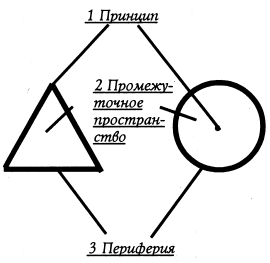
1. Principle
2. Intermediate Space
3. Periphery
In the center of the circle (or at the top of the anthropological and cosmic hierarchy, the vertical) is initiation, authentic esotericism, the Primordial Tradition, the one metaphysics. This is the inner sphere, the sphere of those initiated beyond confessional differences, those who have crossed over and remain beyond the threshold of genuine esoteric organizations.
On the periphery (the horizontal plane) are the profane and the un-initiated. For them, the oneness of truth is hidden behind a variety of forms and labyrinths of moral-ethical standards. These are ordinary people who are not conscious of the true nature of things and events.
Finally, lying beyond the periphery, at the lower point of the vertical axis, is something in the likes of an “anti-center.” This is counter-initiation, the place of the “saints of Satan.” Counter-initiation unites various tendencies not in a luminous synthesis, but in a dark mixture of infernal parody.
This model is obviously transparent and convincing. But the first difficulties arise when we attempt to explain the historical and geographical location of counter-initiatic centers. At this point, it turns out that it is quite difficult to distinguish such centers from properly initiatic societies and orders. Determining on which side of the periphery — the inner or outer, the upper or lower — can be found this or that initiatic organization reveals itself to be extremely difficult (if not altogether impossible), and all external criteria can easily be simulated. Guénon specified that true esotericism is always metaphysically oriented, whereas counter-initiation remains on the level of cosmology or the “subtle world.” However, an enormous distance separates the profane world and the world of metaphysical principles. In the early stages, it is absolutely impossible to predict for sure whether an initiate will reach the end of this path, the actual metaphysical levels, or whether he will get stuck in the intermediary spheres. And if he “gets stuck”, then how does he differ from a representative of counter-initiation?
In other words, up to a certain point (and rather far away from the sphere of the competence of the profane), the paths of initiation and counter-initiation are not only parallel, but essentially one. With respect to the orientations of “above” and “below” (which from the outside might at first seem to be convincing criteria) it should be noted that they are not indicative in direct initiatic experience, since ascent in the borderline sphere between the worldly and otherworldly is often accomplished by means of descent, a departure which leads straight into the abyss.10
If one makes it to the end of this path, the adept attains effective metaphysical realization. If one goes astray, all the attributes of counter-initiation will be glaring.
In other words, from this simple tripartite schema arises a more complex and less edifying picture where the main emphasis lands not on the orientation of movement, but on the reality of the achieved result. Thus, the problem of counter-initiation boils down to an incomplete and imperfect esoteric realization, not some kind of primordially and strictly “Satanically-oriented” secret society conspiring to create and strengthen anti-sacral civilization. The anti-sacral civilization which indeed has been built and is being built today should be seen as the result of the overlapping of many incomplete realizations, first and foremost of an esoteric nature, and the solidarity here is glaringly obvious in those who, within the framework of their own sacred form, are content with half-hearted, unfinished tendencies.
The preponderance of profanity, fed by the spilling over of general degeneration, is only a consequence of the degeneration of initiatic organizations themselves, which, contradicting their primordial orientation, are now content with intermediate surrogates and unrealized potencies instead of unceasingly and heroically striving towards the center of metaphysics. At the same time, that very “demonizing” force commonly referred to as “devilish” and “satanic” can hardly be held responsible for participating in this entire process. In fact, the most terrible and formidable results of perversion and de-sacralization are those achieved by people who have the best intentions and are convinced that they are orthodox bearers of the most obvious good. Every initiate who has a lukewarm attitude towards his spiritual path, every cleric who considers his tradition and its dogma to be an ethical or moral convention, and every Traditionalist who is content to settle down with reciting the phrases of their master, which are evidently correct but rendered meaningless by the mental laziness of their followers — all of these types, little by little, build the structures of counter-initiation and sever the metaphysical apex from the pyramid of initiatic realization.
Among those whom it is easiest to single out as being “representatives of counter-initiation” on the basis of purely external criteria — e.g., open “Luciferians” or “Satanists” — what is sometimes present is actually tragedy, pain, non-conformism, and the ability to peer into the eyes of the terrible truth of apocalyptic reality. Hence why they cannot fulfill the role of the main “scapegoats” for Traditionalists. Of course, some of them may be in solidarity with processes of de-sacralization, but this is more of an exception. On the contrary, more often than not (at least among those who take the matter seriously), we are dealing with a revolt against de-sacralization, conformism, and the degenerate world — a world to which many representatives of “orthodox” traditions, oddly enough, easily adapt and in which they manage to beautifully and comfortably set themselves up.
More often than not, religious non-conformists (“heretics”, “Satanists”, etc.) are seeking the totality of sacral experience which the representatives of orthodoxy cannot offer them. This is not their fault, but their misfortune, and the true fault lies with those who have allowed authentic tradition to be turned into a flat facade behind which there is simply nothing. Perhaps it is none other than these “dubious” forces and groups who are desperately, perplexedly, yet nevertheless stubbornly and heroically pursuing esotericism and initiation deep within reality, while the profane and the moralizing conformists who remain on the periphery of initiation are the ones hindering this path by all means.
If initiation and counter-initiation can be distinguished only in terms of the concrete experience of spiritual realization, then no external criteria can help on this matter.
This conclusion begs itself even if we recognize the universality of esotericism, a point on which Guénon insisted. It remains valid when we apply it to the esotericism of one sacred form taken individually. When we take into consideration the metaphysical contradictions which exist between different forms, then the matter becomes even more complicated.
From the “Red Donkey” to the Roman Pope
The main examples of counter-initiation to which Guénon pointed included the cult of the Egyptian god Set, remnants of which have survived since the most ancient times, along with various snake cults in the Middle East. From Guénon’s point of view, the mysterious brotherhood of the “Red Donkey” (or Dragon) exists to this day and is secretly steering the main processes of civilization in an infernal vein. If we digress from the “detective” flavor of this conceptualization, another consideration presents itself: How could an esoteric group of people engaged in the sacred, albeit in such an infernal, serpentine, and possibly fragmentary aspect, have provoked the modern world’s complete neglect of the sacred and contributed to the widespread assertion of the primacy of the quantitative and the radically anti-initiatic approach that is characteristic of the modern way of life? Compared to the maniacal system of global lies which we see in the modern mass media, secular utilitarian culture, and everyday lifestyles, any “snake-worshippers” would be an exotic and quite sympathetic group of romantic marginals. Behind the anti-sacral aggression of the modern world, there must be a reality which is much more formidable and much more thorough than the machinations of some exotic “black magicians.” It is hardly likely that the scraps of ancient cults, even the most sinister ones, could be responsible for the anti-sacral collapse of the modern world. It is hardly likely that a dark and obviously small sect wields such universality to the point that, in theory, it would be capable of effectively influencing the most important events of world history and, most importantly, shaping the prevailing intellectual climate. If something of this sort really has taken place, then such an organization could not possibly have gone unnoticed, and there would be certain information about it in circulation which, although distorted, approximate, and amiss, would nonetheless be extensive.
It is another matter if we were to attribute the role of counter-initiation to the bearers of a certain metaphysical tradition that is radically opposed to the dominant religious culture. For example, an altogether respectable and pious Parsi (Zoroastrian) could end up in India and, in one way or another, gain access to influence over the most important spheres.11 In the context of Hinduism, he would fulfill an openly counter-initiatic function, insofar as Zoroastrian metaphysics is founded on the principle of Dvaita, whereas the metaphysical axis of Hinduism is Advaita. Such metaphysical subversion would be much more destructive than, say, the antinomies posed by radical Shaivist sects which, while being ethically questionable (the ritual devouring of people, sinister necromantic practices in wastelands and cemeteries, their Tantric orgies, etc.), do not call into doubt the main metaphysical line of Advaita-Vedanta, but, on the contrary, even strengthen, affirm, and defend it.
The activities of a Kabbalist Jew within, say, the Islamic tradition or a Christian country, would be just as counter-initiatic in character, and the (negative) effectiveness of such would be higher in relation to the depth and sophistication with which the Kabbalist understands the metaphysics of his own tradition (and not vice versa).12 Strictly speaking, an Orthodox metaphysician who is perfectly conscious of all the metaphysical implications of the dogma of the Trinity, who understands the whole depth of the contradictions between the Christian Gospel and the alienated creationism of Judaism and Islam, would by the will of fate become involved in the most important culturo-religious questions in the countries and cultures associated with the strict Abrahamic tradition, and could deal irreparable damage to their official ideology (and ultimately culture and politics). (Naturally, this would be “damage” from the point of view of the stability and preservation of Abrahamic creativity in its previous form). In practice, the presence of such overt or covert religious (and esoteric) groups in different states is an obvious fact, while the “snake-worshipers” are either completely unknown or are extravagant, marginal oddities.
Now let us turn to Western civilization, which is the cradle of anti-sacral tendencies. In the West, the counter-initiatic tendencies that ultimately yielded the monstrous result that we see today developed in several stages. The first stage, associated with Orthodox eschatology, was neglected by Guénon, who had a clearly inadequate opinion of the Christian tradition. This first stage consisted of Rome’s falling away from Orthodoxy, the changing of the Symbol of Faith by Charlemagne, and the transition from the Orthodox and eschatological concept of the “symphony of powers” (associated with the metaphysics of the “withholder”, the Katechon) to the Papist (Guelphian) model, against which stood the Ghibelline Hohenstaufen emperors who were just as dear to Guénon as they are to us. Thus, the main sources of counter-initiation in the West should be sought in Catholic Scholasticism and the Vatican.
Unlike Orthodoxy, Catholicism lost its esoteric component, and this gave rise to a whole spectrum of initiatic organizations of various stripes (Hermetic, proto-Masonic, etc.). Given that these initiatic organizations stemmed from an extra-Christian context (from pre-Christian cults and the Islamic and Jewish traditions), any alliance with the exoteric church was founded not on synthesis and organic unity, but on conformism and conventions. This Catholic civilization was so inorganic and unstable that even in its better periods (such as the Middle Ages), it harbored a number of dubious and at times openly counter-initiatic elements.
This unsustainable compromise was ultimately shaken, and both components of the Western tradition came into open contradiction. Catholicism rejected non-Christian esotericism and finally descended to the level of contradictory, secularized Judeo-Christian morality. Autonomous esotericism, in the form of Freemasonry, became a destructive, rationalistic apparatus, in essence anti-Christian and anti-esoteric. These halves of the disintegrating ensemble were marked by counter-initiatic features: in the very least, in the majority of cases, the spiritual path towards metaphysical realization could not be stopped at the first stages, but it was simulated, forged, alienated, and turned into its opposite. The very first and most significant chord of such degeneration was the rejection of the completeness of Orthodox metaphysics. This was the most decisive step in the direction of counter-initiation within the Christian world. After having remained for quite some time within the realm of fully-fledged, unified (at once Orthodox and Catholic) Christianity, which had preserved the fullness of its authentic metaphysics and initiation, the peoples and states of the West eventually, in one catastrophic moment, severed this chain. This was enshrined in the introduction of the dogma of the Filioque and in the Frankish kings’ sacrally-unauthorized appropriation of the status of “Emperors” for their lineage13 (which destroyed the symphony of powers in the West). Catholic (and later altogether secularized-Protestant) moralism and the anti-clerical, bureaucratic, philanthrophico-demagogic rationalism of Masonry — all of this was much more counter-initiatic from the standpoint of fully-fledged Orthodox metaphysics than any splashes of anti-Church, pagan, or even “Luciferian” cults in the West, which perhaps represented but paroxysms of nostalgia for fully-fledged and total Tradition, not even a hint of which had remained in the West since time immemorial.
It is this combination of Western anti-metaphysical Christianity (Catholicism and especially Anglo-Saxon Protestantism) and rationalistic Masonry (with the active participation of the Jewish factor, which played a significant conceptual role in the degradation of the West — after all, the fall of Edom, the “Christian world”, is the condition of the triumph of Judaic messianism14) that lies at the heart of the poisonous paradigm of the modern world. The role of “Satanists” or “representatives of the Order of Set” in all of this is not only negligible, but generally naught, especially since the very fact of such an order’s existence is presumptive and based on extremely dubious evidence. Guénon cited the illustration of an artist from Cairo depicting a strange monster, the statue of which he allegedly saw in a secret sanctuary!15 What would Guénon have said about the paintings of Dali, Ernst, or thousands of other avant-garde artists who have depicted monstrous creatures on their canvases and told thousands of hallucinatory and narcotic tales?
Very telling in this regard is the story of Léo Taxil, the scandalous late-19th-century author behind forged revelations of the machinations of “Satanists.” For Catholics, Léo Taxil described the secrets of “Satanic Freemasonry”, while for Masons he exposed the “perversions” and “black book magic” of the Catholic clergy. In fact, beyond his clearly adventurous personal aims, Taxil quite cleverly showed how representatives of both Western organizations (one embodying exotericism, the other esotericism) were not so much “devil-worshipers” as much as gullible fools. This grotesque idiocy on the part of both conservatives and progressives is perhaps the most expressive sign of the parody which Guénon himself called the easily recognizable “seal of the devil.”
At any rate, Traditionalists and Guénon’s followers have not managed to avoid the same lot, as they have gone so far in uncritically repeating various (and often frankly disputable) maxims of the master that they have reached the very same level of “scholastic parody”, the signs of which were clearly noticed by the much wiser and non-conformist (although no less controversial) Baron Julius Evola.
The Absence of Counter-Initiatic Symbolism in the Primordial Tradition
Now a few words about the Primordial Tradition. From our point of view, the contours of this Tradition were outlined with astonishing clarity in the works of the German Professor Herman Wirth, a review of whose book Guénon published in Études Traditionnelles.16 According to Wirth, all existing mythological plots, symbols, religious dogma and rituals, and moreover all human languages and alphabets, evolved from a single calendric proto-form: the Sacred Circle, covered with an arrangement of proto-runic signs.17 This proto-form was a description of the natural phenomena observed by humanity at the North Pole on the ancient continent of Hyperborea (or Arctogaia18), which has since disappeared. Thus, out of a rather abstract concept, the Primordial Tradition becomes the tangible and concrete reality of a paradigm, the basic contours of which have been extremely convincingly and voluminously revealed by Herman Wirth.19
What interests us in the Hyperborean calendric proto-form is that region which is associated with the dark, nocturnal sectors, corresponding to the Polar Night and its related symbolism. This is the period of the winter solstice, or Great Yule, the main festival, symbolic, and ritual center of the entire structure of the Primordial Tradition.
Counter-initiation, according to Guénon’s definition, is related to the negative aspects of universal symbolism and, as follows, in the Hyperborean array corresponds to those realities describing the state of the Polar Night, the decline of the sun, and other symbolic analogies of this event. The snake and wolf often function as such symbols, frequently imagined as swallowing the sun in the polar winter. This darkness is also identifiable with Mother-Earth, from which all living beings come and whither all return to be reborn again.
This primordial picture, which is strictly cyclical and harmonious, preceded the division of this symbolic complex into positive and negative elements. The snake, the wolf, darkness, the subterranean regions (where the sun descends), death, and night — none of these have strictly negative significations. All aspects of the cycle are equally important and necessary — sunset is just as sacred as sunrise, and without the sun’s “dying,” there can be no spring, no rebirth in the New Year. Therefore, the same symbols have both negative and positive aspects. This is an essential point: at hand is not an artificial theological concept seeking to consciously identify positive in negative and negative in positive (like the famous Chinese symbol of Yin-Yang), but rather a special state of consciousness which, in principle, does not know the very idea of negative.20 It is precisely by virtue of this state that Tradition is indeed Primordial and Integral, preceding any particular interpretation. The possibility for different interpretations of this primordial symbolism is embedded in the overall picture, and such interpretations are what constitute the content (and background) of historical religions and mythologies which evolved into stable symbolical and doctrinal complexes at the cost of metaphysically and ethically emphasizing only certain aspects of the one Hyperborean proto-form to the detriment of others.
It can be said that the “Hyperborean Tradition” was simultaneously dual and non-dual, trinitarian and unitary, monotheistic and polytheistic, matriarchal and patriarchal, sedentary and nomadic. Only later did it split into several branches separated from and opposed to one another.
The Primordial Tradition does not annul the metaphysical differences between traditions, since it is strictly neutral in this regard. It provides a general context, an unfolding of a system of correspondences and symbolic series which allow one to explain the most mysterious and darkest aspects of symbolism, mythologies, religious doctrines, and sacred tropes. With respect to metaphysics, this Primordial Tradition is limited to being a mere statement of fact. The metaphysical question attains its real intensity in completely different conditions, those which are maximally removed from the Golden Age of the polar civilization. This, in fact, is why it is impossible to agree with Guénon on the esoteric unity of traditions, since they are not unified on a metaphysical level, but rather unified in the sense of descending from a single sacred cult-symbological complex which is a universal language, the basic element of all the varieties of human culture and human religion. This language can serve to express the most diverse theological and metaphysical constructs, but they all concern one and the same archetypal structure, which they merely interpret and whose metaphysical accents they re-arrange in different ways.
Therefore, the symbolic complex which can be associated with counter-initiation in its most universal aspect should be that relating to the Hyperborean mystery of Yule. A strictly negative interpretation of this complex can lead to grotesque distortions, to the point that the most important and sacred aspects are treated as “counter-initiatic.”
This, according to Herman Wirth, is what happened with the Christian tradition when it equated various “solstitial” Hyperborean tropes with demonic realities, even though their symbolisms are strikingly reminiscent of the calendric history of the birth of the Son of God (the winter solstice).21
For instance, the demon’s tail was a vestige of the solar-solstice rune connoting the lower part of the polar year and the roots of the world tree. The cauldrons in which the demons cooked sinners were derived from the trope of the winter cauldron (or vessel) of the gods — the cauldron of the Celtic god Dagda which never runs empty. This is a typical winter-solstice motif (the New-Year rune itself was still called Dagda in the Normans’ time, and was depicted as a bowl or cauldron). The horns of the “devil” are a symbol of the spring Resurrection of the sun, as they are the symbolic analogue of two raised hands — the spring rune ka.22 And so on.
These considerations show that it is impossible to judge the counter-initiatic character of one or another symbol or symbological complex in terms of purely formal attributes — in Hyperborean symbolism, which lies at the heart of all sacred symbolism, such symbols simply do not exist.
Conclusion
Summating our brief analysis, it should be clear that it is necessary to radically reconsider Guénon’s theory of counter-initiation and carefully think through the various standpoints involved in this matter. This problem is closely connected to other theses of Guénon’s which, upon attentive study and application to concrete historical religions and initiatic schools, turn out to be too rough, inaccurate, or frankly erroneous. At the same time, this revision in no way tarnishes the high authority of René Guénon, for without his works and his most important theses and interpretive models, the whole picture of esotericism and metaphysics would be hopelessly confused today. The point is not to debunk the master, as some of his ungrateful students, such as Frithjof Schuon, have sought to do. On the contrary, it is necessary to clarify and hone the great intuitions of this genius in order to cleanse his teachings of all that has turned out wrong, and in order to make shine with new strength and freshness those aspects which are expressions of the purest truth. Guénon gave us an invaluable tool, a wonderful methodology for studying Tradition. Thanks to him, we can determine the common denominators of the enormous materials of theology, the history of religions, initiation, etc., which would otherwise remain hopelessly contradictory fragments defying any systematization (not to mention neo-spiritualist reconstructions or the theories of profane historians and ethnologists). Guénon remains the main and key author. But if we, following serious reflections and the results of careful research, arrive at conclusions which do not concur with his views and instead correct them, then it is pointless to try to conceal them and pretend that everything remains unchanged.
The question of counter-initiation is highly important and extremely relevant. So is the question of the existence (or non-existence) of a real metaphysical unity of traditions.
The present text is merely an introduction to this problem, a sketch for further research that is of colossal significance. We hope to develop this topic in subsequent works.
In the meanwhile, let us remark that an adequate notion of counter-initiation, a clarification of its character, essence, and “localization”, will lead us to the most horrifying secrets which, hidden behind the dubious myth of the modern world, are ready to find their nightmarish, chilling incarnation in front of a hopelessly slumbering humanity drowsily wandering towards slaughter. Unlike naive stories about an “Order of the Red Donkey” and exotic and relatively harmless “Luciferians”, the true mission of counter-initiation is dizzyingly large-scale, effective, and ubiquitous. It is preparing a terrible fate for all peoples and civilizations. But in order to recognize this approaching catastrophe, it is necessary to look at things soberly and intently beyond the romantic haze of residual occultism and the “detective plots” of cheap horror novels.
Nothing rejoices the “enemy of humankind” more than the deafening stupidity of those who hastily decide to embark on the path of struggle against him without seriously weighing all the circumstances and assessing the whole volume of that unfathomable and terrible problem which St. Paul the Apostle called the “mystery of iniquity.”
READ MORE from PRAV Publishing:
Passages: Studies in Traditionalism and Traditions
Volume I (2023)
Volume II (2025)
Volume III [forthcoming in Fall 2026]

René Guénon, Le règne de la quantité et les signes des temps (Paris: Gallimard, 1945).
In fairness, it must be noted that the Hindu Traditionalist Ananda Coomaraswamy, whom Guénon held in high regard, recognized Buddhism to be a fully-fledged tradition.
Despite the fact that Guénon wrote very little about Islamic tradition, the majority of his theses on the esoteric question arose precisely out of the Islamic views on things, albeit in the esoteric sector. Hindu Advaita-Vedanta and Sufi Islam were dear to Guénon. The specific approaches to esotericism proper to these two traditions considerably shaped Guénon’s preferences and assessments in the domain of historical religions and their dogmas. Regardless of how logical or harmonious these two systems might be, they still far from exhaust all the possible variations of esoteric and initiatic doctrines. *[Ed.: In the first edition of this essay, Dugin adds to this note: “We have addressed this topic in detail in Alexander Dugin, Metafizika Blagoi Vesti. Pravoslavny ezoterizm [The Metaphysics of the Gospel: Orthodox Esotericism] (Moscow: Arktogeia, 1996). This work contains a detailed scrutiny of Guénon’s Christological views as arising from his confessional belonging to Islam, not from any correspondences between their ‘univocal esoteric truth.’”]*
See Alexander Dugin, “Messianstvo Kabbaly” [The Messianism of Kabbalah] in Konets Sveta [The End of the World] (Moscow: Arktogeia, 1998).
Christianity is counted among the Abrahamic traditions only in the Islamic perspective and in some Judeo-Christian currents. Orthodoxy cannot define itself in this way since it clearly recognizes its inner spiritual nature to belong to a tradition that is Melchizedekian, pre-Abrahamic, post-Abrahamic, and supra-Abrahamic all at the same time.
See Dugin, “Messianstvo Kabbaly,” op. cit.
See Alexander Dugin, Metafizika Blagoi Vesti. Pravoslavnyi ezoterizm [Metaphysics of the Gospel: Orthodox Esotericism] [Moscow: Arktogeia, 1996; reprinted in Absoliutnaia Rodina (Moscow: Arktogeia, 1999)], Chapter 41.
Ibid.
Is this, in fact, the case? The logic of our analysis shows that everything is much more complicated.
Let us recall the initiatic journey of Dante, who at the very bottom of the funnel of Hell proceeded to climb even lower down the body of Satan, but thereby ended up not in the center of the abyss, but on the surface of the earth beside the hill crowned by earthly paradise. to this category also belongs a range of symbols which put paradise under the earth and demons on the peak of mountains, etc.
For example, Indira Gandhi’s husband was a Parsi.
This is the case of the Dönmeh, followers of the Jewish pseudo-messiah Sabbatai Zevi (17th century), who outwardly converted to Islam following their leader’s example, and who, in the 20th century, came to head the Turkish government, which immediately abolished Islam as the state religion and declared the establishment of a “Western-style civilization” in Turkey. It should be noted that, while remaining entirely traditional with regard to the esoteric Kabbalistic community and loyal to the broader context of the Jewish diaspora, the Dönmeh nevertheless carried out a purely anti-sacred and anti-Islamic, profane mission if viewed from an orthodox Islamic perspective.
See Dugin, Metafizika Blagoi Vesti [Metaphysics of the Gospel].
See Dugin, “Messianstvo Kabbaly,” op. cit.
Here is an excerpt from a letter that Guénon wrote to a certain Hillel in 1930, describing this story: “Here, near Al-Azhar (Cairo University), there is an elderly gentleman who bears a striking resemblance to the portraits of ancient Greek philosophers and who creates strange paintings. Once he showed us a drawing of a dragon with the head of a bearded man, wearing a 16th-century hat, and with six small heads of various animals protruding from his beard. It is particularly curious that this figure closely resembles an image from the International Review of Secret Societies [Revue internationale des sociétés secrètes], featured there as an illustration for the famous book The Dragon’s Chosen One. This image appears to have been taken from some ancient book […]. But the real kicker is that this gentleman claims he actually saw this head and drew it exactly as it appeared in the original!”
See Mily Angel no. 1 (1990).
See Herman Wirth, “Sviashchennyi God” [The Sacred Year] in Konets Sveta [The End of the World], op. cit.; Alexander Dugin, “Kosmicheskii Spasitel’” in Konets Sveta [republished as a chapter of Misterii Evrazii (Mysteries of Eurasia) in Absoliutnaia Rodina].
*[Ed.: In Dugin’s Russian: Arktogeia, with Dugin’s eponymous website and publishing house name transliterated as Arctogaia; in Wirth’s German: Arktogäa.]*
See Alexander Dugin, Giperboreiskaia teoriia [The Hyperborean Theory] (Moscow: Tsentr EON, 1992; Moscow: Arktogeia, 1993).
Modern linguistics divides types of thinking into two main categories: “digital” thinking and “analog” thinking. “Digital” thinking, which corresponds precisely to positivism and materialism, operates with abstract categories — “is” and “is not” — and functions according to the laws of formal logic (the law of the excluded middle, the law of identity, etc.). The term “analogical thinking” arose from the study of archaic, primitive peoples and their cultures and mythologies. “Analogical thinking,” corresponding to the world of Tradition and having retained a connection to traces of the Hyperborean doctrine, knows no “pure negation.” “No” here means “another yes”; pure absence is inconceivable, but the concept of “absence” immediately evokes the image of “another presence.” “Analogical thinking” first affirms a holistic image and only then breaks it down into categories such as “presence,” “absence,” “positive”–“negative,” and even “male”–“female,” “large”–“small.” In “analogical thinking,” there is no strict distinction between the subject of an action and its object, between a substance and an attribute, or between a verb and a noun. Therefore, in our case, the sun and its disappearance—its absence—appear as a single, unified whole; the affirmation “the sun” already contains its negation (setting in winter), and the negation “winter darkness” contains the affirmation (the absence of the sun attests to its significance). Based on this logic, primordial symbolism is, in principle, not subject to moral interpretation — it consists of a system of interconnected, integral sacred elements, none of which are endowed with a priority in terms of value. Everything here is an expression of a unified sacred existence, the Light of the World in various stages of its cyclical pulse.
See Dugin, "Kosmicheskii Spasitel’” [Cosmic Savior] in Misterii Evrazii [Mysteries of Eurasia], op. cit.

 | A guest post by
|
"It is hardly likely that a dark and obviously small sect wields such universality to the point that, in theory, it would be capable of effectively influencing the most important events of world history and, most importantly, shaping the prevailing intellectual climate. If something of this sort really has taken place, then such an organization could not possibly have gone unnoticed, and there would be certain information about it in circulation which, although distorted, approximate, and amiss, would nonetheless be extensive." .............Alexander Dugin's essay is a difficult read but the above statement is relatively clear, and in my opinion wrong. There is a small sect "capable of effectively influencing the most important events of world history" which has not gone unoticed.
Grazie