



It would be difficult to find philosophical teachings and worldviews more differing in their appearance and presentation than Traditionalism and American Pragmatism. While Traditionalism aspires towards higher, transcendent worlds and is deeply critical of everything modern, Pragmatism is psychological and strives to use its methods to give seekers a solid foundation in the present moment and the strength to go through difficult events. At the same time, upon properly delving into the philosophical work of William James (1842-1910), we can see striking instances of Pragmatism coinciding with Traditionalism in its interpretation of ways of living through and overcoming the most difficult spiritual crises that people face in the modern world. Drawing on the works of James, René Guénon (1886-1951), and Julius Evola (1898-1974), this article attempts to interpret the relation of these two doctrines from the perspective of their philosophical grounding of the spiritual quest and the existential way out of the “darkness of mechanicism.”
To achieve this goal, we will briefly examine the main ideas of James and the Traditionalists on the standpoint of overcoming the internal crises faced by sensitive human types, compare their main approaches in terms of their similarities and differences, and then offer our own optic on the results of such a comparative analysis, which we believe to be constructive from an existential point of view — primarily in overcoming the “dark night of the soul” that every person living on Earth and capable of deep feeling faces during periods of severe life trials.
William James’ Psychology of Spiritual Experience: Towards a Pragmatism of the Sacred
William James, along with Charles Peirce and John Dewey, is one of the founders of the philosophy of Pragmatism, one of the two originally American philosophical doctrines — the other being Transcendentalism (Ralph Waldo Emerson and Henry David Thoreau) that emerged across the Atlantic in the second half of the 19th century. Pragmatism can be academically defined as a philosophical tradition which maintains that the key criteria for the value of an idea are its practical usefulness and applicability. Essentially opposed to Cartesian rationalism, Pragmatism is based on the principles of empirical verification and rejects the rationalist belief in the value of “reasonably constructed” theories. Because of this, philosophers of this school were often (quite unfairly) accused of relativism.
In essence, Pragmatism is still poorly understood (outside the US and Italy, where it was one of the leading trends in academic philosophy in the early 20th century). However, a careful reading of the classics of Pragmatism — imbued as they are with the poorly concealed spirit of Hegelianism (especially in the cases of James and Royce) and deeply influenced by classical German idealism — allows us to conclude that this movement is characterized by a heightened “sensitivity” to the subtle perception of truths otherwise radically rejected by the rationalism of the Modern age (“New Time”) and the Enlightenment.
In particular, Pragmatism devotes heightened attention to the empirical perception of the individual experience of the subject (including spiritual experience); it does not reject “out of hand” whatever might seem to be “unreasonable” from an “Enlightenment” position; it offers clear empirical criteria for scienticity (anticipating its time); it does not separate ideas from their implementation in the world (a spirit close to the traditional one), and it pays considerable attention to the context of a particular experience, event, or perception.
The above is particularly noticeable upon an attentive reading of William James’ works, especially his works on the philosophy and psychology of religion, among which the most significant for us are the collection of essays The Will to Believe (1897) and the book The Varieties of Religious Experience (1902). William’s father, Henry James, was a great admirer of the insights of the Swedish spiritualist Emanuel Swedenborg, which defined the spiritual climate in his family and imparted a considerable interest in the sacred in general. William James spent his childhood and youth traveling around the world, taking part in an expedition to South America, to the Amazon delta. Suffering from various health problems (including psychological problems) throughout his youth, during his years of study, James discovered the works of the French neo-Kantian Charles Renouvier (1815–1903), which defined the direction of his philosophical seeking (in particular, he was inspired by Renouvier’s maxim, “My first act of free will must be to believe in free will”).
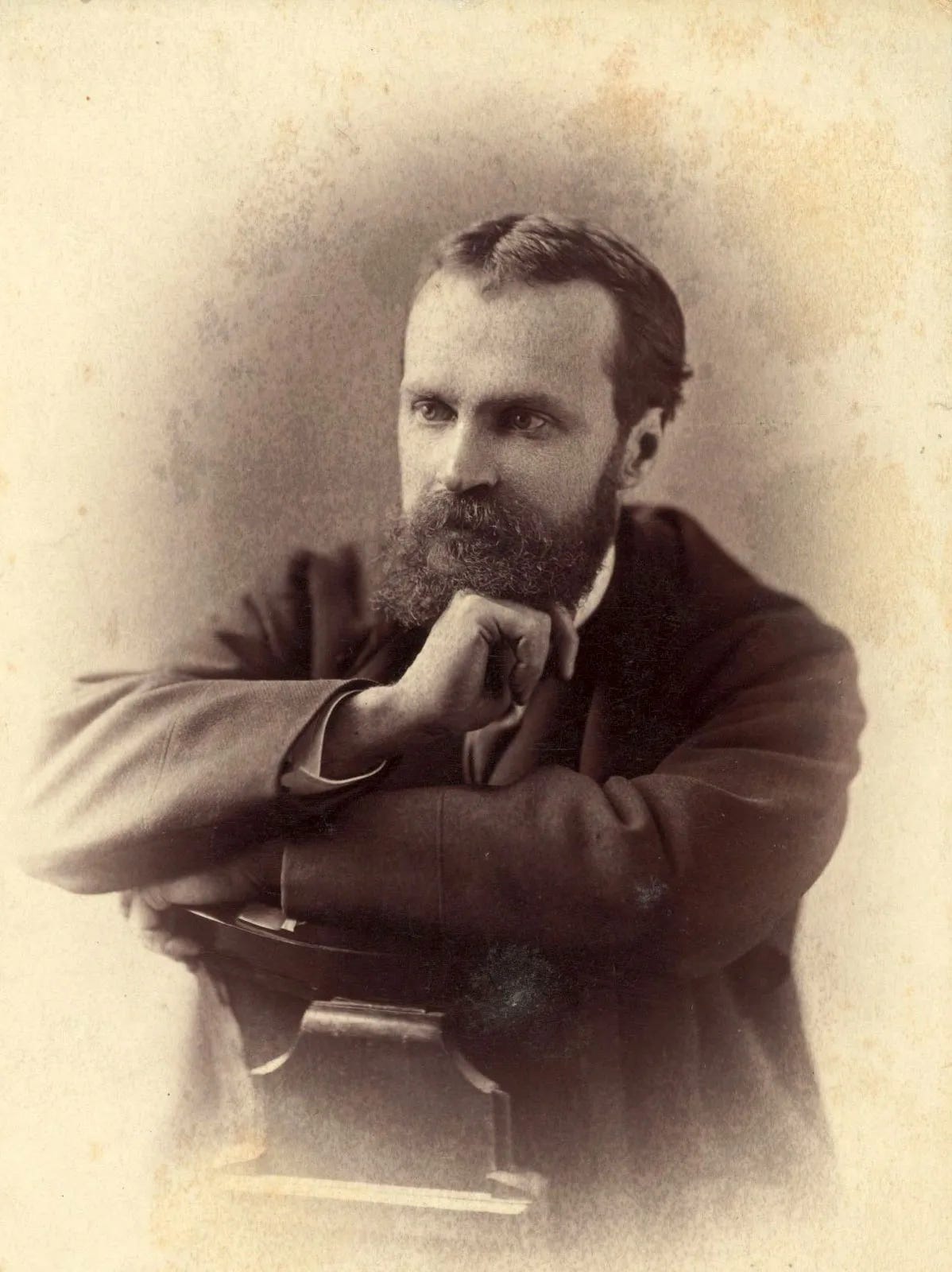
Having found the vector of his intellectual and spiritual movement, James, who was not at all inclined to sympathize with institutional forms of Christianity, directed his search toward psychology as a new science of consciousness. Having achieved worldwide fame after the publication of The Principles of Psychology in 1890 and becoming president of the American Psychological Association in 1894, James immersed himself in the questions that had most excited him since childhood and youth, namely, the study of spiritual experience, its empirical influence on individual consciousness, considering the empirical experience of the Divine, questions of posthumous existence, and defending the principle of free will in opposition to all forms of determinism. Over the course of this research, William James became a member of H. P. Blavatsky’s Theosophical Society in 1882.
Taking on Pragmatism as a methodology for scientific research under the influence of Charles Peirce during his years of teaching at Harvard allowed James to reinforce his own work with a coherent theory of truth, which includes a general theory of belief. In particular, he came to the conclusion that there must be a strict correlation between an idea and the reality that is the object of that idea. The “objective reality” behind an idea may not be true; at the same time, it exists as given in belief and has an empirically manifested influence.
Thus, what is truly significant for the American philosopher are the direct empirical consequences of a particular belief, rather than its “rational outline,” which may be altogether absent and irrelevant altogether. If a particular idea has “worked” and guided us through the trials and tribulations of a changing and dangerous world, then it is undoubtedly true. This maxim of Pragmatism allows us to move away from decadent determinism and explore what James calls the “actual universe,” i.e., the world of our experience, including that which is most valuable to us: the spiritual. It allows us to overcome rationalism, that intellectual disease of the modern age, which, according to James, always creates “closed systems” from which there is no escape.
In his essay “The Will to Believe,” the American philosopher asserts: “In concreto, the freedom to believe can only cover living options which the intellect of the individual cannot by itself resolve; and living options never seem absurdities to him who has them to consider.”1 Thus, James defends freedom of spiritual choice from the standpoint of Pragmatism and psychology; as a supporter of pluralism, James consistently refutes the claims of skepticism, rationalism, and dogmatic religions (primarily Christianity) to the “exclusive right” to the truth.
In his work “Is Life Worth Living?” — included in the same collection as “The Will to Believe” — the American philosopher considers the various depressing aspects of human nature:
But [life] feels like a real fight; as if there were something really wild in the Universe which we, with all our idealities and faithfulnesses, are needed to redeem. And first of all to redeem our own hearts from atheisms and fears. For such a half-wild, half-saved universe our nature is adapted. The deepest thing in our nature in this Binnenleben (as a German doctor lately has called it), this dumb region of the heart in which we dwell alone with our willingnesses and unwillingnesses, our faiths and fears. As through the cracks and crannies of subterranean caverns the earth’s bosom exudes its waters, which then form the fountain-heads of springs, so in these crepuscular depths of personality the sources of all our outer deeds and decisions take their rise. Here is our deepest organ of communication with the nature of things…2
Concluding this work, James appeals to his readers:
“Be not afraid of life. Believe that life is worth living, and your belief will help create the fact.”3
In The Varieties of Religious Experience, the American philosopher emphasizes that he is interested exclusively in what he calls “personal religion,” i.e., the complex arrangement of an individual’s inner spiritual beliefs apart from any rite or denomination:
when in our definition of religion we speak of the individual’s relation to what he considers the ‘divine,’ we must interpret the term ‘divine’ very broadly, as denoting any object that is godlike, whether it be a concrete deity or not… What then is that essentially godlike quality — be it embodied in a concrete deity or not — our relation to which determines our character as religious men? For one thing, gods are conceived to be first things in the way of being and power. They overarch and envelop, and from them there is no escape. What relates to them is the first and last word in the way of truth. Whatever then were most primal and enveloping and deeply true might at this rate be treated as godlike, and a man’s religion might thus be identified with his attitude, whatever it might be, towards what he felt to be the primal truth.4
James sets himself the task of studying those characteristics of the human spirit that make it possible to “believe in the reality of the invisible.” He argues that the “invisible” is significantly more important than the “tangible” because ideal objects (or ideas) elicit an absolutely credible response in us that leads to specific actions, attitudes, and practices. Some people, however, are able to experience this empirically, as evidenced by their individual experiences: “We may now lay it down as certain that in the distinctively religious sphere of experience, many persons (how many we cannot tell) possess the objects of their belief, not in the form of mere conceptions which their intellect accepts as true, but rather in the form of quasi-sensible realities directly apprehended.”5
The philosopher points out that “personal religious experience has its root and centre in mystical states of consciousness.”6 James clarifies that by “mystical” he does not mean something insubstantial, sentimental, and vague, but rather a specific experience that corresponds to four criteria: ineffability, intuitiveness, transiency, and “passivity of the will.”7 In analyzing mystical states, the American scholar emphasizes non-Christian forms of spiritual life. In particular, he pays considerable attention to yoga:
In India, training in mystical insight has been known from time immemorial under the name of yoga. Yoga means the experimental union of the individual with the divine. It is based on persevering exercise; and the diet, posture, breathing, intellectual concentration, and moral discipline vary slightly in the different systems which teach it. The yogi, or disciple, who has by these means overcome the obscurations of his lower nature sufficiently, enters into the condition termed samadhi, “and comes face to face with facts which no instinct or reason can ever know.”... The Vedantists say that one may stumble into superconsciousness sporadically, without the previous discipline, but it is then impure. Their test of its purity, like our test of religion’s value, is empirical: its fruits must be good for life. When a man comes out of Samadhi, they assure us that he remains “enlightened, a sage, a prophet, a saint, his whole character changed, his life changed, illumined.”8
Continuing this argument, James examines the state of dhyana in Buddhism as well as Sufi practices.
Religious life, the American scholar concludes, bears upon a special aspect of human nature: “its manifestations so frequently connect themselves with the subconscious part of our existence.”9 James adds: “the visible world is part of a more spiritual universe from which it draws its chief significance,” and “union or harmonious relation with that higher universe is our true end.”10 Our “inner communication with the spirit of this higher world” helps us achieve this goal. This is “a real process in which spiritual energy is manifested.” Thus, in religion (“religious life” or “personal religion,” as defined by James), we have “new zest which adds itself like a gift to life, and takes the form either of lyrical enchantment or of appeal to earnestness and heroism,” as well as “assurance of safety and a temper of peace, and, in relation to others, a preponderance of loving affections.”11
How, then, can we define the philosopher’s own views? Reflecting on this, he notes: “It would never do for us to place ourselves offhand at the position of a particular theology, the Christian theology, for example, and proceed immediately to define the ‘more’ as Jehovah, and the ‘union’ as his imputation to us of the righteousness of Christ. That would be unfair to other religions, and, from our present standpoint at least, would be an over-belief.”12 At the same time, James points out: “whatever it may be on its farther side, the ‘more’ with which in religious experience we feel ourselves connected is on its hither side the subconscious continuation of our conscious life.”13 Moreover, according to the American scholar, “the conscious person is continuous with a wider self through which saving experiences come, a positive content of religious experience which, it seems to me, is literally and objectively true as far as it goes.”14
Concluding his argument on what Traditionalists would call the “transcendent,” James asserts:
we belong to it in a more intimate sense than that in which we belong to the visible world, for we belong in the most intimate sense wherever our ideals belong. Yet the unseen region in question is not merely ideal, for it produces effects in this world. When we commune with it, work is actually done upon our finite personality, for we are turned into new men, and consequences in the way of conduct follow in the natural world upon our regenerative change.15
James’ own “super-belief” comes closest to the pantheistic idea of a “world soul” from which we originate and which each of us becomes a part of after death. He deems this idea (his “personal religion”) optimistic and consistent with the truths conveyed by the mystical experiences of representatives of various traditions. Moreover, reflecting on his own beliefs, James writes the following: “Notwithstanding my own inability to accept either popular Christianity or scholastic theism, I suppose that my belief that in communion with the Ideal new force comes into the world, and new departures are made here below, subjects me to being classed among the supernaturalists of the piecemeal or crasser type.”16 The American philosopher also writes that he agrees “in principle” with the doctrine of karma and is critical of Kantian-style detached idealism, insisting instead on the real and tangible (empirical) presence of higher forces in the world.
René Guénon: The Experience of Overcoming
the Distortions of the “World of Quantity”
The French philosopher René Guénon (1886–1951), the founder of the current of thought known as Traditionalism, was emphatically critical of contemporary academic psychology. In the chapter “Sacred and Profane Science” of his work The Crisis of the Modern World (1927), Guénon states:
One could show for instance that psychology as it is understood today — that is, the study of mental phenomena as such — is a natural product of Anglo-Saxon empiricism and of the eighteenth century mentality, and that the point of view to which it corresponds was so negligible for the ancient world that, even if it was sometimes taken incidentally into consideration, no one would have dreamed of making a special science of it, since anything of value that it might contain was trans- formed and assimilated in higher points of view.17
The French philosopher criticizes the very foundations of modern science, asserting the primacy of intellectual intuition through which the Traditional World understood the surrounding reality more correctly and perceived it more sensitively.
Guénon’s attitude toward psychology is linked to his criticism of quantitative methods:
the claim to reduce quality to quantity is very typical of modern science. This tendency has reached the point of supposing that there can be no science, in the real meaning of the word, except where it is possible to introduce measurement, and that there can be no scientific laws except those that express quantitative relations. It is a tendency that arose with the mechanism of Descartes; since then it has become more and more pronounced, notwithstanding the rejection of Cartesian physics, for it is not bound up with any particular physical theory, but with a general conception of scientific knowledge. Today, attempts are made to apply measurement even in the psychological field, the very nature of which excludes such a method. The point has been reached of no longer understanding that the possibility of measurement derives from a quality inherent in matter, that is to say from its indefinite divisibility.18
This perception of psychology as a tendency to reduce the transcendent to the purely human is also expressed in other works by the French philosopher. For example, in Perspectives on Initiation (1946), he writes: “some have tried to create a ‘psychology of symbolism’, something connected to that specifically modern error of ‘psychologism’ which is itself only a particular case of the tendency to reduce everything to exclusively human elements.”19 Furthermore, discussing the mystery of initiatic trials, Guénon emphasizes: “Indeed, ultimately the so-called ‘psychological’ explanations are equally worthless, even if they have a subtler veneer; for they all similarly neglect the only thing that really counts, that is, that the effective action of the rites is not a ‘belief’ or a theory, but a positive fact.”20
In his work The Reign of Quantity and the Signs of the Times (1945), Guénon directly refers to William James’ Varieties of Religious Experience and criticizes the latter’s conclusions:
In the domain of philosophy and psychology, the tendencies corresponding to the second phase of anti-traditional action are naturally marked by the importance assigned to the ‘subconscious’ in all its forms, in other words to the most inferior psychic elements of the human being, something particularly apparent so far as philosophy properly so called is concerned in the theories of William James as well as in the ‘intuitionism’ of Bergson.21
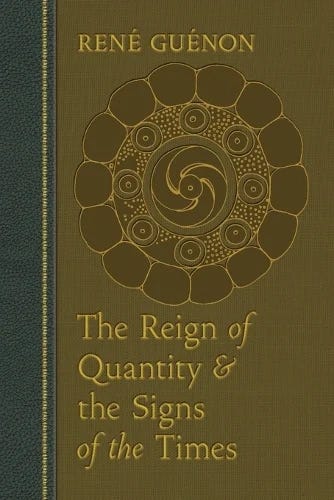
Combining James’ Pragmatism and Henri Bergson’s intuitionism into a single set of theories, Guénon critiques these concepts for perceiving reality as “becoming,” whereas, according to his view, the metaphysical is always an “immutable principle.” Further on in the same work, Guénon opposes the “confusion” of the psychic and the spiritual, since the psychic, in his view, originates from the “lower” structures of the transcendent order, while the spiritual (especially when correctly transmitted through initiation) is directed toward its higher planes.
How does the French philosopher suggest overcoming (on an individual level) the distortions of the world of quantity, which has “hardened” and turned away from the traditional spirit? In The Crisis of the Modern World, Guénon writes:
As we have said many times already, the starting-point of everything should be knowledge; and thus what appears to be most remote from the practical order is nevertheless the most potent even within this order, since it is impossible here as anywhere else to accomplish without it anything of real value or anything that will prove more than a vain and superficial agitation.22
In this view, the true goal is the “metaphysical realization” of the individual, the essence of which is discussed in detail by the French philosopher in his work Oriental Metaphysics. Guénon writes of
the infinite expansion of this individuality, whose physical modality, the only one developed in the ordinary person, represents only a minimal part of it. It is from this modality that the path actually begins, which is why methods of a sensory nature used at first must, however, find resonance in other modalities of the human being. The phase we are talking about is, in essence, the realization or development of all the possibilities virtually contained in human individuality and forming, as it were, its manifold extensions, extending in various directions beyond the realm of the physical and sensory. And it is precisely through these extensions that it will then be possible to establish a connection with other states. Such a realization of integral individuality is referred to by all traditions as the restoration of what is called the “original state,” a state that is considered to be the state of the true human being and which already escapes the limitations characteristic of the ordinary state, in particular, that which is caused by temporal conditioning. A being who has attained this “original state” still remains only an individual human being, who has not actually mastered any supra-individual state; and yet, from now on, he is freed from time, since the visible sequence of phenomena has been transformed for him into simultaneity.23
Thus, insisting on the “immutability” of the truly metaphysical, Guénon sees an individual way out of the distortions of the “world of quantity” through initiation into a living tradition by means of a correctly received initiatic experience. It should be noted that he personally demonstrated that such a path can be effective for certain types of people: after deep disappointment in Western occultism (in particular, in Martinism), the French philosopher moved to Cairo, where he converted to Islam, joined the family of a Sufi sheikh, had four children, and then lived a peaceful life as a devout Muslim to the end of his days. It is also important to note that in his personal spiritual practice, Guénon resorted exclusively to Islam, seeing in it the very “way out” and rootedness in what he extolled in his works as “authentic and immutable metaphysics.”
Julius Evola: From Magical Idealism
to the Traditionalist Ontology
of Revolt Against the Modern World
In one of our previous works,24 we provided “keys” to an existential reading of the works pertaining to the later creative period of the Italian Traditionalist Julius Evola (1898–1974). In particular, with reference to Evola’s works Metaphysics of Sex (1958) and Ride the Tiger (1961), we drew attention to the fact that, in his later works:
Julius Evola sets the task of helping the differentiated man develop his own path in a world that is alien to him, expressed in the following dimensions: (1) one must recognize the correct ontology, based on an acceptance of transcendence; (2) one must adhere to a clear, existential mode of action, based on the principles of inviolability, centrality, unmotivated action, and “contemplation of death”; (3) in the case of a conscientious rejection of “unitarity,” one must agree only to a union with a partner who is worthy, who existentially corresponds to traditional parameters.25
In other words, by limiting the circle of people who are existentially capable of perceiving such theses to the definition of “individuals of a special type,” which is difficult to disagree with, Evola gives a set of advice and explanations from the height of his acquired and lived experience on how, even in the decadent “world of ruins” that the modern world undoubtedly is, one can build a conscious and spiritual life that is not devoid of meaning. Moreover, he does so while resorting to the tools of simple language, devoid of the complexity of the terminology of academic idealistic philosophy which he used in the 1920s. In essence, in our opinion, this approach is quite pragmatic and aimed at helping people (primarily young people) improve their mental health through a return to Tradition and a genuinely spiritual mindset.
In this work, we would like to note some obvious differences between Evola’s Traditionalism and Pragmatism, as well as share a number of similarities we have identified. Evola’s critical stance toward academic psychology remained unchanged throughout his life, as evidenced in his work The Mask and Face of Modern Spiritualism (1932),26 and references to this can also be found in Ride the Tiger. At the same time, the Italian thinker’s critique is directed primarily against Freudianism and Freud’s “simplification” of both the individual and his consciousness to various impulses related to sexuality. Of course, Evola rejected any biological reductionism, which is why his ideas and approaches can hardly be compared to any of the classics of Pragmatism — with the exception of William James, with his supernaturalistic beliefs and epistemology of radical empiricism.
It is the combination of the latter two philosophical positions that paves the way for a productive comparison with Evola’s concepts. Here we should touch not so much on the post-war (so-called “existential”) period of the Italian thinker’s work, but rather on his pre-war works in the field of idealistic philosophy (works aimed at substantiating the concept of “magical idealism”) and his fundamental ontology as set forth in Revolt Against the Modern World (1934).
During the period of magical idealism (the 1920s), Julius Evola constructed a coherent and consistent philosophical concept that earned the praise of Italy’s leading idealist philosophers, led by Benedetto Croce. Inspired by Fichte, Schelling, and Vico, the Italian philosopher introduced elements of Eastern wisdom into the idealistic system popular at the time, in particular, certain tenets of Taoism. The result of his philosophical work can be briefly characterized as a conception of the “I” (“absolute individual”) as a will liberated from external conditions, believing in itself and acquiring the “power of God,” and with it, total self-control, becoming a truly free “infinite energy” that builds its own immortality. According to the early Evola, the true existential task of the individual is “magical growth,” i.e., working on “self-creation to become an absolute individual.” The Italian thinker set a similar task for himself, which served as the occasion for taking an interest in the theory and practice of Tantra, Hermeticism, and alchemy.
Discussing operative magic in his Essays on Magical Idealism (1925), Evola asserts:
The fundamental principle of magic is that the way the world appears to us is not an extreme case, that it is not irreversible in itself, but rather is a phenomenon corresponding to the pure power of the ‘I’: then, acting on the transcendental plane of samskâra, we are capable of removing the conditions under which reality appears and, consequently, the concrete experience of the universe.27
Thus, the “I” of the early Evola acts as the co-creator of the universe or, if you will, the “co-Lord,” and these properties, which the Italian thinker emphasizes separately and in a completely “Greek” style, apply not only to the spirit, but also to the body — this is the meaning of his concept of “immanentization of the transcendent,” or the transitions carried out by the will and “magical power” between the immaterial and the corporeal, between “two worlds.”
Having noted the above, let us move on to Evola’s ontology as detailed in Revolt, a work written in a language familiar to readers of the Italian thinker and characteristic of Traditionalism. Discussing the traditional spirit, Evola states the following:
there is a physical order of things and a metaphysical one; there is a mortal nature and an immortal one; there is the superior realm of “being” and the inferior realm of “becoming.” Generally speaking, there is a visible and tangible dimension and, prior to and beyond it, an invisible and intangible dimension that is the support, the source, and true life of the former.28
This worldview, which the Italian thinker calls the “doctrine of two natures,” is characteristic of the traditional world, regardless of geography and cultural specifics.
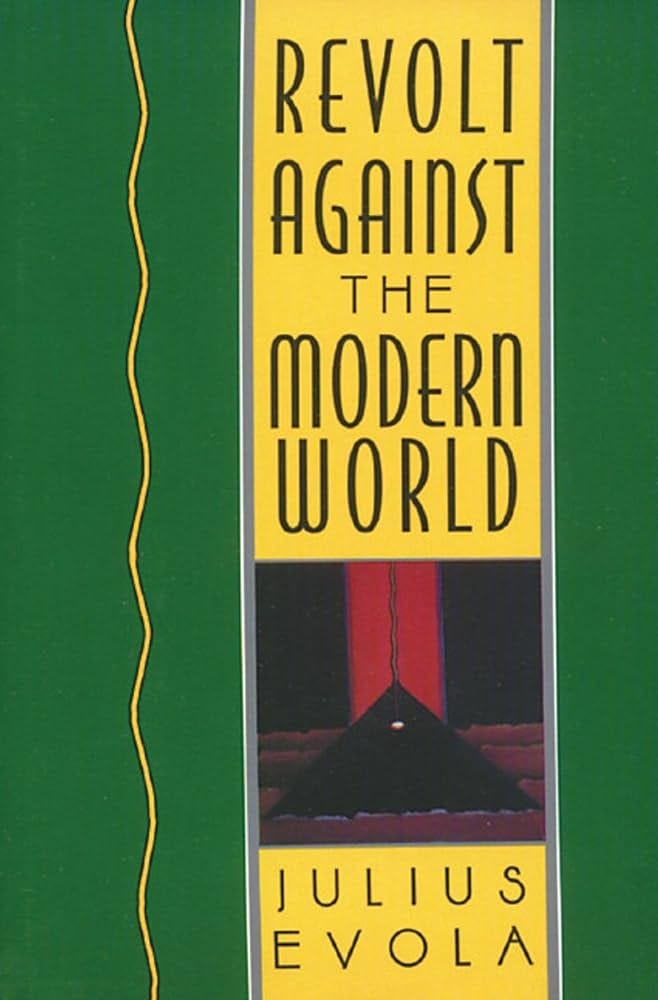
Continuing his argument, Evola reproaches the typical modern person for the fact that his “experience no longer extends to nonphysical realities,” whereas for traditional man, “the ‘invisible’ was an element as real, if not more real, than the data provided by the physical senses.”29 Thus, the Italian Traditionalist emphasizes that the “higher world of being” can (and should) be given to us in experience, and not only and not so much in representation.30 In the World of Tradition, there were special initiatory procedures aimed at awakening this world in a person: “Initiation,” Evola writes, is the action that determines an ontological transformation of man. High-level initiation has generated initiatory chains that were often invisible and subterranean and that preserved an identical spiritual influence and an ‘inner doctrine’ superior to the exoteric and religious forms of a historical tradition.”31
In Revolt, Evola examines in detail various aspects of initiation in the consecration of a ruler into his rank, using the examples of ancient Egyptian32 and ancient Greek traditions; throughout the book, he emphasizes several times that initiation itself is understood precisely as an “ontological change of nature”33 in a broader sense. The essence of ontological transformation is the elevation above the “game of lower nature” and the progressive transition into the sacred space. This change opens “the way to Shambhala,” which cannot be found geographically, for it is contained “in one’s spirit.”34
In his later (post-war) works, Julius Evola acknowledges that the traditional path of awakening through initiation is practically inaccessible to people in the modern world. In Ride the Tiger, he points out that there are three possibilities leading to an ontological change of state: (1) if a person possesses a different power from birth; (2) awakening through a deep crisis, spiritual trauma, desperate actions (“Here it is possible that if the person is not wrecked, he may be led to participate in that force, even without his having held it consciously as a goal”35); (3) traditional initiation through the influence of a representative of an existing initiatory organization.
The Italian thinker points out that René Guénon always considered only the third path, whereas, in Evola’s opinion, only the first two are realistic in the modern world. Evola asserts:
A realistic view of the situation and an honest self-evaluation indicate that the only serious and essential task today is to give ever more emphasis to the dimension of transcendence in oneself, more or less concealed as it may be. Study of traditional wisdom and knowledge of its doctrines may assist, but they will not be effective without a progressive change affecting the existential plane, and more particularly, the basic life force of oneself as a person: that force that for most people is bound to the world and is simply the will to live… When the orientation toward the transcendent no longer has a merely mental or emotional character, but has come to penetrate a person’s being, the most essential work is done, the seed has penetrated the earth, and the rest is, in a way, secondary and consequential.36
Thus, our “sense of the transcendent” can be either innate or acquired. In the latter case, in order to correctly perceive this force and turn it to our advantage, we need preliminary preparation that allows us to go through this metamorphosis consciously. The properties of the “dark age,” so hostile to the living sacred, leave us the opportunity, under certain conditions, as Otto Rahn wrote, to “pick up the key to the gate leading to the Garden of Roses,” that is, to the space of the Spirit, to Eternity.

Traditionalism and Pragmatism:
Comparing the Incomparable
In The Varieties of Religious Experience, William James summarizes his lengthy historical and philosophical deliberation thusly:
An American philosopher of eminent originality, Mr. Charles Sanders Peirce, has rendered thought a service by disentangling from the particulars of its application the principle by which these men were instinctively guided, and by singling it out as fundamental and giving to it a Greek name. He calls it the principle of pragmatism, and he defends it somewhat as follows: — Thought in movement has for its only conceivable motive the attainment of belief, or thought at rest. Only when our thought about a subject has found its rest in belief can our action on the subject firmly and safely begin. Beliefs, in short, are rules for action; and the whole function of thinking is but one step in the production of active habits.37
The “achievement of certainty” of which Peirce speaks is for different types of people preceded by various metamorphoses, by spiritual and intellectual seeking. For example, the “certainty” of a scientist of the Modern age and the Enlightenment is a consequence of a system of rationally constructed conclusions. “Certainty” of the Traditionalist type is based not on a system of logical constructs, but on an immanent sense of the sacred. For René Guénon, it is reflected in the concept of the “immovable metaphysical,” for Julius Evola the “immanentization of the transcendent” and the magical manipulation of the higher forces inherent in the world. Both key figures of Traditionalism can be classified, according to William James’ categorization, as “twice-born souls.”
The American philosopher calls those who have developed mentally and spiritually in a straightforward, natural way and without internal crises “once-born souls.” In the Traditionalist worldview, this definition may correspond to an individual who has not been torn from the traditional context and lives his life in the mainstream of a unified and living spiritual tradition. “Suffering souls,” on the contrary, are not predisposed to the peaceful integrity of the “once-born,” and Traditionalists would say that the vast majority of people in the modern world are internally “suffering” due to the existing conditions of decline. “Twice-bornness” is a way out of the state of “suffering” through the rediscovery of spiritual certainty and solid foundations that allow a person not to merely survive, but to exist productively in the world. James believed that the “psychological basis of the twice-born character seems to be a certain discordancy or heterogeneity in the native temperament of the subject, an incompletely unified moral and intellectual constitution.”38 Traditionalists, of course, have found and convincingly presented other reasons that point to the deeper aspects and articulate the mass nature of this problem.
It should be noted that Traditionalism itself as a phenomenon is quite understandable through William James’ model. René Guénon, finding nothing in the West that satisfied him spiritually, found his personal peace and tranquility in Islam, undergoing the appropriate initiation and adopting a number of orthodox practices to which he remained faithful until his dying day. Julius Evola, having reached the age of 23 and endeavoring to commit suicide out of existential despair, rejection of the world, and the meaninglessness of life, initially found salvation in the Majjhima Nikāya and Theravada Buddhism, later supplementing his “rebirth” with Tantric practice and Hermetic teachings.
READ MORE:

Guénon, Evola, and Tantra with Nietzsche

Excerpt from Julius Evola: An Adventurous Life by Andrea Scarabelli (PRAV Publishing & Arktos, 2026).
Another important thinker of the Traditionalist school worth mentioning here, Frithjof Schuon (1907-1998), was “reborn” several times during his life, moving from Protestantism to Islam and then to the spiritual traditions of the Native Americans. All three were perennialists, but they saw the Sophia Perennis in different forms. Finding a spiritual world that was suitable and appropriate for each of them with the power of what Peirce called “certainty” allowed Guénon, Evola, and Schuon not only to find a productive personal way out of the crises of “suffering souls” but also to make a tremendous contribution with their invaluable creativity to helping seekers around the world overcome similar crises. Expanding on Charles Peirce’s definition, we could say that achieving “certainty” is the true motive not only for intellectual work, but also for spiritual work. The path thereto differs for everyone.
René Guénon, as we noted above, identified the “immovable transcendent,” or the “genuine metaphysical,” as the basis of his personal “certainty.” It manifests itself in “positive facts,” i.e., a direct impact on the empirical reality perceived by each of us. The French philosopher saw the only way to achieve this in the modern world in proper initiation and the real influence of rituals, which defined his personal choice.
Julius Evola, in turn, wrote about the need for “magical work” aimed at the individual’s acquisition of the qualities of being a Lord. According to Evola, the correctness of such work guarantees individual immortality. At the same time, as the Italian thinker showed by his own example, a life lived in constant self-creation acquires meaning in itself and allows one to reveal human potential even on the “lower” side of the “two natures.”
None of the above examples contradicts the approach to the study of the sacred put forth by Jamesian Pragmatism. James’ teaching is pluralistic and, by definition, opposed to any religious dogmatism (in the confessional sense). Pragmatism, like Traditionalism, considers the spiritual to be directly influencing the world and perceptible in empirical experience (as an “object of internal work,” if you will). Moreover, the spiritual world itself is also considered to be a given whose ontological status is no lesser than the material world.
Finally, it bears noting that Pragmatism is epistemologically opposed to modern rationalism, since Descartes is considered a key intellectual opponent by all the classics of Pragmatism (including James). Pragmatism is by definition an “open system,” while rationalism is dogmatic and confines all phenomena of existence to the steel cage of reason. In view of this, Guénon’s criticism of mechanicism is fully shared by James himself, who states in his work Pragmatism: “The optimism of present-day rationalism sounds just as shallow to the fact-loving mind. The actual universe is a thing wide open, but rationalism makes systems, and systems must be closed.”39
No genuine spiritual experience can be “closed,” for this contradicts both the very nature of the spirit and the fact that spiritual life requires constant practice. In the conditions of the crisis of the modern world, it is problematic to demand that spiritual life correspond exactly to the requirements that were satisfied in the World of Tradition; at the same time, spiritual contact with the sacred (in Evola’s terms, “magical work”) is always a living process, not an abstract conclusion, and it has entirely empirical consequences, on which point the ideas characteristic of both Pragmatism and Traditionalism are quite similar.
Conclusion
To conclude our discussion, let us return once more to William James’ reasoning on the philosophy of Pragmatism’s perception of the spiritual:
The world interpreted religiously is not the materialistic world over again, with an altered expression; it must have, over and above the altered expression, a natural constitution different at some point from that which a materialistic world would have. It must be such that different events can be expected in it, different conduct must be required. This thoroughly ‘pragmatic’ view of religion has usually been taken as a matter of course by common men. They have interpolated divine miracles into the field of nature, they have built a heaven out beyond the grave. It is only transcendentalist metaphysicians who think that, without adding any concrete details to Nature, or subtracting any, but by simply calling it the expression of absolute spirit, you make it more divine just as it stands. I believe the pragmatic way of taking religion to be the deeper way. It gives it body as well as soul, it makes it claim, as everything real must claim, some characteristic realm of fact as its very own. What the more characteristically divine facts are, apart from the actual inflow of energy in the faith-state and the prayer-state, I know not. But the over-belief on which I am ready to make my personal venture is that they exist. The whole drift of my education goes to persuade me that the world of our present consciousness is only one out of many worlds of consciousness that exist, and that those other worlds must contain experiences which have a meaning for our life also; and that although in the main their experiences and those of this world keep discrete, yet the two become continuous at certain points, and higher energies filter in. By being faithful in my poor measure to this over-belief, I seem to myself to keep more sane and true.40
The “realm of fact” of the spiritual world mentioned by James here is the higher of the “two natures.” It is a manifestation of the reality to which we truly belong before our specific incarnation, and to which our return is the only inevitable fact of our human existence. Without this understanding and without systematic recourse to the “world above,” a person cannot endure the most difficult trials that fall to his lot and the sufferings he experiences in empirical experience. Spiritual crises caused by both external and internal reasons, which, following Juan de la Cruz, can be called “the dark night of the soul,” are an integral part of any person’s life; the experience of living through and overcoming them is one of the most important components of human existence in the world. What do we tune into when we encounter this state? First and foremost, the transcendent — in a form that resonates with our souls:
How sweet it is for me to know the fount that flows
in the darkness of this night!
This eternal fount is hidden from view,
But I know the place where it quietly flows
in the darkness of this night.41
Depending on tradition and worldview, the force that sustains us in living through the “dark night of the soul” can be perceived both as an external, transcendent will or as an inherent, internal quality. The diversity of traditional interpretations of this transcendent “certainty,” which allows us to be reborn “while alive,” speaks mainly of stylistic differences. What is essentially important is the certainty of spiritual experience and its empirically perceptible and practical impact (in Guénon’s terms, the “positive facts” of the influence of the spiritual on the worldly). In the world of Modernity and Postmodernity, there are no universal “recipes” that suit everyone; after all, each of us experiences the “dark night of the soul” on our own, and we are free to choose individual solutions in search of the “qualities of the Lord” or “rebirth.” A favorable resolution of the spiritual problem can allow us, even in the darkest night, to see the path to the light:
Its waters flow, filled with coolness,
and there is no limit to them, and there is no barrier to them
in the darkness of this night.
The crystal of these waters will never be eclipsed,
but the light of the whole earth will be born in them from eternity
in the darkness of this night.42
Translated by Jafe Arnold
This essay by Dmitry Moiseev is excerpted from the third volume of Passages: Studies in Traditionalism and Traditions — hot off the press from PRAV Publishing:

William James, Volia k vere (Moscow: Respublika, 1997), 24 [The Will to Believe and Other Essays in Popular Philosophy (New York: Longmans, Green, and Co., 1897), 29].
William James, “Stoit li zhit’?” in Volia k vere, 45 [Is Life Worth Living? (Philadelphia: S. Burns Weston, 1896), 61-62].
Ibid., 45 [63].
William James, Mnogoobrazie religioznogo opyta (Moscow: AST, 2022), 44-45 [The Varieties of Religious Experience: A Study in Human Nature (New York: Longmans, Green, and Co., 1902), 34-35].
Ibid., 72 [64].
Ibid., 368 [370].
Ibid., 369-372 [380-382].
Ibid., 382-383 [401].
Ibid., 458 [478].
Ibid., 460 [485].
Ibid., 461 [485-486].
Ibid., 477 [511].
Ibid., 478 [512].
Ibid., 480 [515].
Ibid., 481 [516].
Ibid., 486 [521].
René Guénon, Krizis sovremennogo mira (Moscow: Eksmo, 2008), 59 [The Crisis of the Modern World, trans. Marco Pallis, Arthur Osborne and Richard C. Nicholson (Hillsdale: Sophia Perennis, 2004), 50].
Ibid., 99 [84].
René Guénon, “Zametki ob initsiatsii” in ibid., 247 [Perspectives on Initiation, trans. Henry D. Fohr, ed. Samuel D. Fohr (Hillsdale: Sophia Perennis, 2004), 124].
Ibid., 296 [Ibid., 170].
René Guénon, Tsarstvo kolichestva i znameniia vremeni in ibid., 633 [The Reign of Quantity and the Signs of the Times, trans. Lord Northbourne (Hillsdale: Sophia Perennis, 2004), 220].
Ibid., 126 [Crisis, 108].
René Guénon, Vostochnaia metafizika in idem, Izrannye prozivedeniia: Chelovek i ego osushchestvlenie soglasno Vedante. Vostochnaia metafizika (Moscow: Belovodye, 2004), 240.
Dmitry Moiseev, “The Existential Dimension of Traditionalism in the Works of Julius Evola: Towards the Fundamental Principles of the Being of the Differentiated Man,” trans. Charlie Smith, in Passages: Studies in Traditionalism and Traditions, vol. II (PRAV Publishing, 2025), 309-327.
Ibid., 326-327.
See Julius Evola, Lichina i lik sovremennogo spiritualizma (Moscow: Totenburg, 2020) [The Mask and Face of Contemporary Spiritualism / The Fall of Spirituality: The Corruption of Tradition in the Modern World, trans. John Bruce Leonard (Rochester: Inner Traditions, 2021)].
Julius Evola, Ocherki o magicheskom idealizme (Saint Petersburg: Vladimir Dal’, 2022), 139.
Julius Evola, Vosstanie protiv sovremennogo mira (Moscow: Prometei, 2016), 21 [Evola, Revolt Against the Modern World, trans. Guido Stucco (Rochester, VT: Inner Traditions, 1995), 3].
Ibid., 21-22 [3-4].
Evola reveals how this is possible in his later works: The Yoga of Power: Tantra, Shakti, and the Secret Way (1949) and Ride the Tiger (1961).
Evola, Vosstanie, 105 [Revolt, 66-67].
“The king publicly acknowledged his kingship and paid homage to Osiris by ‘piecing him back together’ and by ritually renewing his death and victory. The king was called ‘Horus who shapes the father (Osiris)’ and also: ‘The giver of life, or he who through the rite makes divine life arise in a regal fashion, like the sun.’ The sovereign became ‘Horus’ who resuscitated Osiris or was the resurrected Osiris himself. Similarly, in the Mysteries, initiates often took their name from the god who had founded those same Mysteries, since the initiation reproduces the same act of natures; sometimes this similarity is figuratively described as ‘incarnation’ or ‘generation.’” Ibid., 58 [31-32].
Ibid., 75 [43].
Ibid., 268 [201].
Julius Evola, Osedlat’ tigra (Saint Petersburg: Vladimir Dal’, 2005), 436 [Ride the Tiger: A Survival Manual for Aristocrats of the Soul, trans. Joscelyn Godwin and Constance Fontana (Rochester, VT: Inner Traditions, 2003), 214].
Ibid., 440 [216-217].
James, Mnogoobrazie religioznogo opyta, 423-424 [Varieties, 444].
Ibid., 168 [167].
William James, Pragmatizm. Novoe nazvanie dlia nekotorykh starykh metodov myshleniia (Saint Petersburg: Shipovnik, 1910), 23 [Pragmatism: A New Name for Some Old Ways of Thinking (New York: Longmans, Green, and Co., 1922), 27].
James, Mnogoobrazie religioznogo opyta, 483-484 [Varieties, 518-519].
Juan de la Cruz, “The Fountain” [translation based on the Russian edition, Istochnik, by L. Vinarova].
Ibid.